
Businesses today are changing faster than ever. Customers expect quick service, employees need better tools, and companies have to manage more data than they did in the past. Because of these changes, many businesses are looking for practical ways to use technology in their daily operations.
This is where digital transformation solutions can make a real difference. They help businesses improve old processes, connect different systems, automate repetitive work, and create better experiences for customers and employees.
Digital transformation is not simply about buying new software or moving files to the cloud. It is about using technology in a smart way to solve real business problems. In this guide, I will explain what digital transformation means, its major benefits, the services involved, the role of AI, and the steps businesses can take to begin their transformation journey.
What Are Digital Transformation Solutions?
Digital transformation solutions are technology-based tools, services, and strategies that help businesses improve the way they operate. They can change how a company manages information, communicates with customers, handles daily tasks, and makes business decisions.
For example, a company that still manages customer information in spreadsheets may move to a cloud-based customer relationship management system. A business that answers every customer question manually may introduce an AI chatbot. Another company may use data analytics to understand sales trends.
These are all examples of digital transformation.
A successful transformation usually combines technology with changes in business processes and employee workflows. The goal is not to use technology simply because it is new. The goal is to use the right technology to make work easier, faster, safer, or more useful.

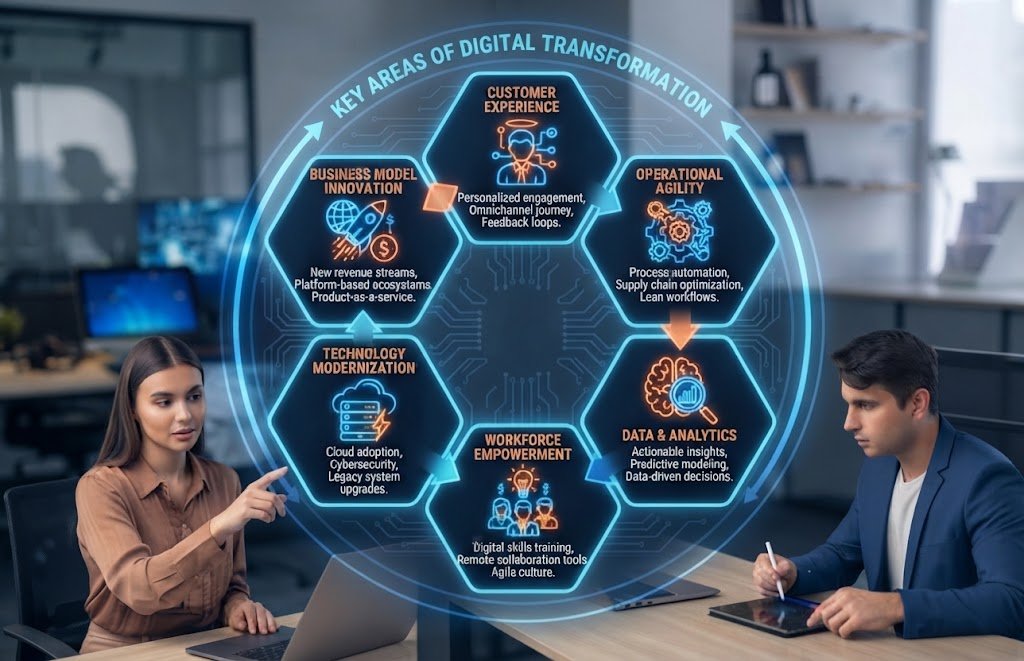
Key Areas of Digital Transformation
Some common areas include:
- Cloud computing
- Artificial intelligence
- Business automation
- Data analytics
- Customer experience technology
- Cybersecurity
- Digital communication tools
- Business software integration
A digital transformation service may focus on one of these areas or combine several of them into a larger business strategy.
Why Do Businesses Need Digital Transformation?
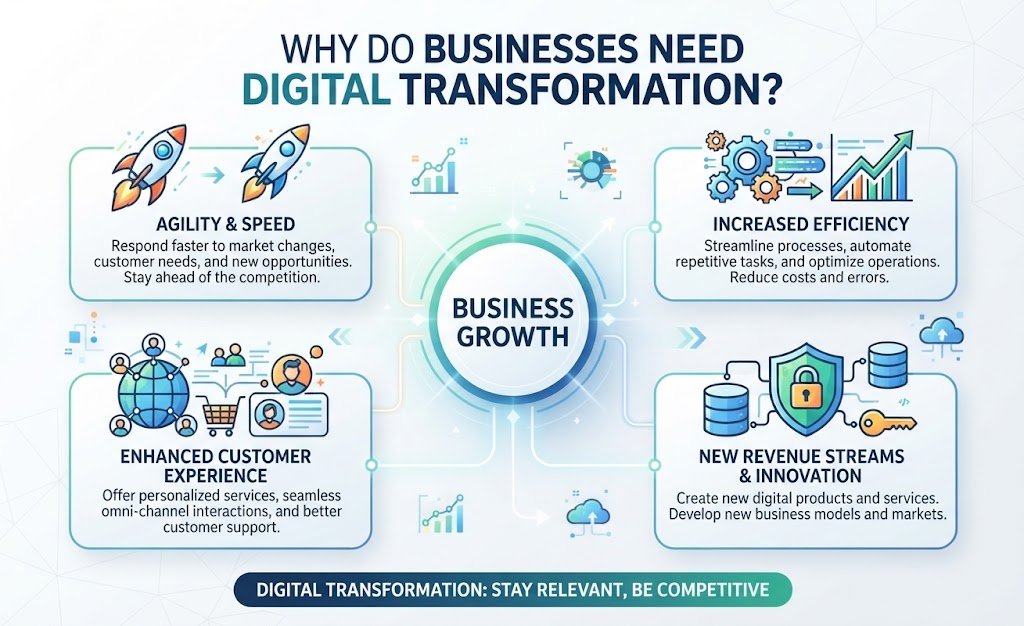
Customer expectations have changed significantly. People are now used to online services, fast communication, mobile applications, and personalized experiences. Businesses that depend heavily on slow manual processes may find it difficult to meet these expectations.
Technology can also help companies manage growing amounts of information. Instead of keeping important data in separate systems, businesses can connect their tools and make information easier to access.
Another reason is productivity. Employees often spend a lot of time doing repetitive tasks such as entering information, creating basic reports, sending routine emails, or moving data between systems. Automation can reduce some of this manual work and allow employees to focus on tasks that require human attention.
A strong digital business transformation strategy can also help a company respond more quickly when customer needs or market conditions change.
However, transformation should always start with a clear business problem. Technology alone does not guarantee better results.
Types of Digital Transformation Solutions
There are many different ways businesses can use technology to improve their operations. The right approach depends on the company’s goals, size, industry, existing systems, and budget.
Cloud-Based Solutions
Cloud technology allows businesses to access applications, storage, and computing resources over the internet. Instead of depending entirely on local servers, companies can use cloud platforms for many different business needs.
Cloud solutions can make it easier for employees to work from different locations. They can also provide businesses with more flexibility when their storage or computing needs change.
Cloud systems may be used for file storage, business applications, databases, collaboration tools, and other services.
AI and Automation Solutions
Artificial intelligence is becoming an important part of modern business technology. AI can help businesses analyze information, respond to customers, identify patterns, and support employees.
Automation is useful for repetitive and rule-based tasks. For example, a company may automate appointment reminders, invoice processing, data entry, or routine customer notifications.
When AI and automation are used carefully, employees can spend less time on repetitive work and more time on activities that need creativity, communication, and judgment.

Data Analytics Solutions
Businesses create large amounts of data through sales, websites, customer interactions, marketing campaigns, and other activities.
Data analytics tools can help turn this information into useful insights. Businesses can use analytics to identify trends, understand customer behavior, track performance, and find areas that may need improvement.
Good data management is important because decisions are only as useful as the information behind them.
Customer Experience Solutions
Customer experience is another important part of digital transformation. Businesses can use websites, mobile applications, online support, customer portals, and personalized communication to make interactions easier.
For example, an online customer portal can allow people to check orders, update information, or find answers without contacting support for every small issue.
The goal should be to make the customer journey simple while still providing human support when it is needed.
Cybersecurity Solutions
As businesses become more dependent on digital systems, cybersecurity becomes increasingly important.
Security solutions can help protect business networks, applications, customer information, and employee accounts. Businesses may use access controls, encryption, security monitoring, backups, and employee training as part of their security strategy.
Cybersecurity should not be treated as an optional extra. It should be considered during the planning and implementation of digital projects.
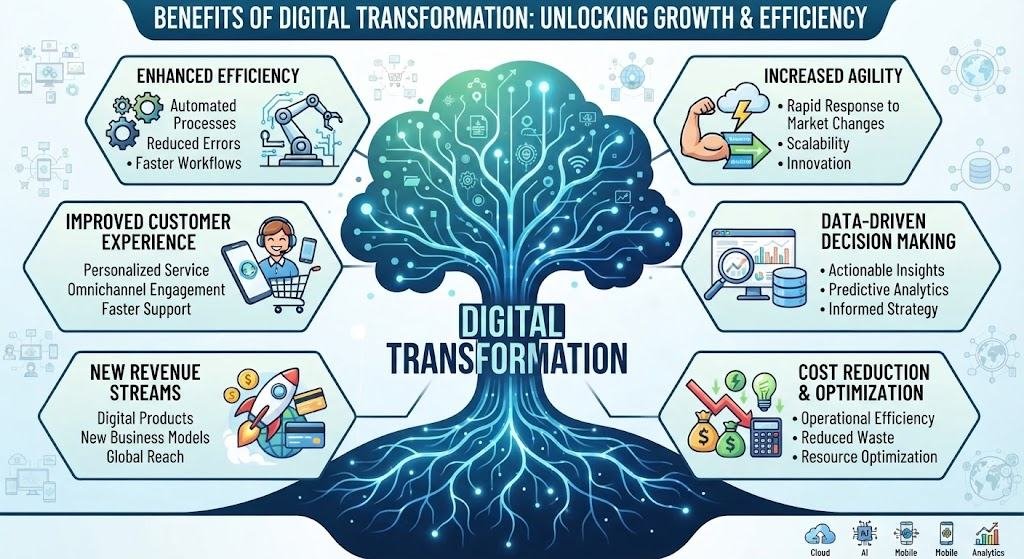
Benefits of Digital Transformation
There are many benefits of digital transformation, but they can vary depending on how a business implements new technology.
One major benefit is improved productivity. When repetitive processes are automated, employees can spend more time on important work.
Another benefit is faster access to information. Connected systems can make it easier for employees to find the data they need instead of searching through multiple files or applications.
Digital tools can also improve customer service. Online support, automated notifications, and self-service options can make it easier for customers to interact with a business.
Other potential benefits include:
- Better operational efficiency
- Faster communication
- Improved data management
- Easier collaboration
- More flexible work processes
- Better customer experiences
- Improved decision-making
- Greater scalability
- Stronger security practices
Cost savings may also be possible when businesses reduce unnecessary manual work or improve inefficient processes. However, digital transformation often requires an initial investment, so companies should measure both costs and expected business value.
Most importantly, the technology should support a clear business goal. A company does not need every new tool available. It needs the tools that solve its actual problems.
How Generative AI Supports Digital Transformation
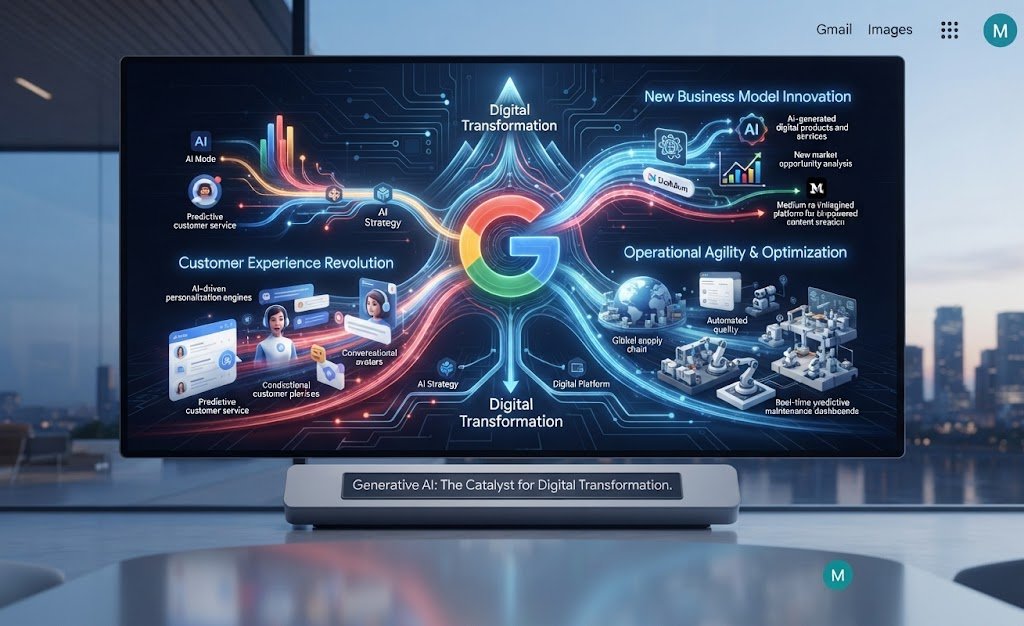
Generative AI can create text, summarize information, generate ideas, assist with coding, and perform other tasks based on user instructions. Because of these capabilities, it can become a useful part of a broader transformation strategy.
But what would be an appropriate task for using generative AI? A good example is creating a first draft of a customer email or summarizing a long internal document.
Other possible uses include:
- Creating content drafts
- Summarizing meeting notes
- Generating brainstorming ideas
- Drafting routine responses
- Organizing information
- Creating basic documentation
- Supporting software development
For example, an employee could ask an AI system to summarize a long report and then review the summary before using it. This can save time while keeping a person involved in the final process.
Generative AI should be used carefully when dealing with confidential information, sensitive customer data, or important decisions. Human review remains important because AI-generated information can contain errors.
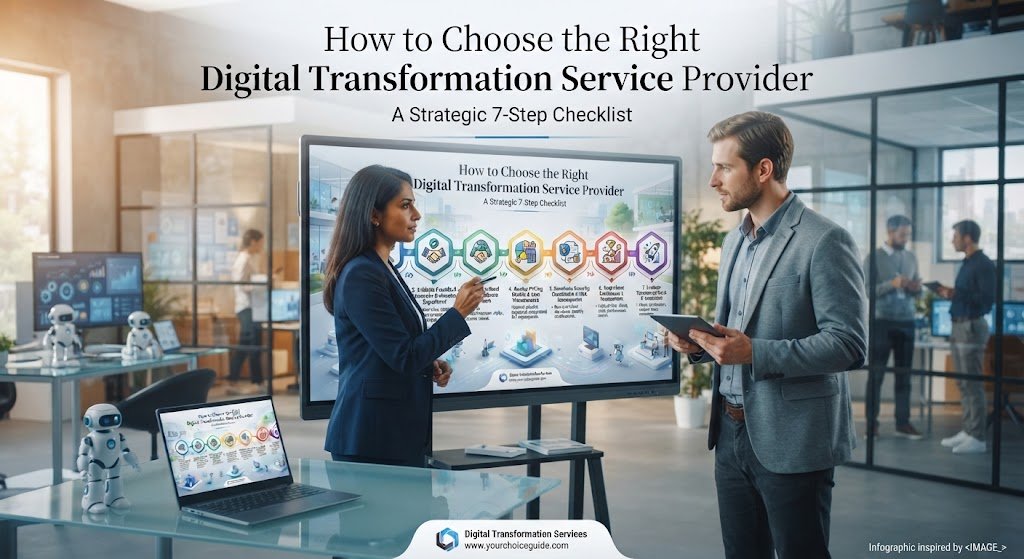
How to Choose the Right Digital Transformation Service
Choosing a digital transformation service should begin with the business problem rather than a specific technology.
First, identify what is not working well. Is the company losing time because of manual processes? Are employees using too many separate systems? Are customers struggling to get support? Is business data difficult to understand?
After identifying the problem, set measurable goals.
Businesses should also consider:
- Existing technology
- Budget
- Security requirements
- Employee skills
- Integration needs
- Scalability
- Vendor support
- Long-term maintenance
It is also helpful to introduce major changes gradually. A smaller project can provide useful lessons before a company invests in a much larger transformation.
The Role of Digital Transformation Companies
Some businesses have internal technology teams, while others work with external digital transformation companies for specialized knowledge.
These companies may provide services such as:
- Digital strategy planning
- Cloud migration
- AI implementation
- Software integration
- Process automation
- Data analytics
- Cybersecurity
- Technology consulting
- Employee training
- Technical support
The role of an external provider should be based on the company’s actual needs. Before selecting a provider, businesses should understand the proposed solution, expected costs, security practices, implementation process, and ongoing support.
A good transformation plan should also consider the people who will use the technology every day. Even a powerful system can create problems if employees do not understand how to use it.
Understanding the Digital Transformation Journey
The digital transformation journey is different for every business. Some companies may begin with a single department, while others may need broader changes across the organization.
A simple journey can include these steps:
1. Identify Business Problems
Start by finding processes that are slow, expensive, difficult, or frustrating.
2. Set Clear Goals
Decide what the business wants to improve. Goals might include reducing processing time, improving customer service, or increasing productivity.
3. Review Existing Systems
Look at current software, hardware, data, and workflows. This helps identify what should stay and what needs improvement.
4. Choose Suitable Technology
Select tools based on business requirements instead of choosing technology simply because it is popular.
5. Start Implementation
Introduce the solution carefully and test important processes before expanding the project.
6. Train Employees
Employees need clear training and support. Communication is an important part of successful change.
7. Measure Results
Track useful metrics before and after implementation. This helps determine whether the project is delivering the expected value.
8. Keep Improving
Digital transformation is not a one-time event. Businesses should continue reviewing their technology and processes as their needs change.
Common Challenges of Digital Transformation
Digital transformation can provide many opportunities, but businesses can also face challenges.
One common problem is resistance to change. Employees may be comfortable with existing processes and need time to understand why a new system is being introduced.
Cost can also be a concern, especially for smaller businesses. Other challenges include outdated systems, limited technical skills, data security risks, integration problems, and poor planning.
The best way to reduce these problems is to create a realistic plan before implementation. Businesses should communicate changes clearly, provide employee training, protect important data, and introduce major projects in manageable stages.
The Future of Digital Transformation
Technology will continue to influence how businesses operate. Generative AI, automation, cloud computing, data analytics, connected devices, and cybersecurity are likely to remain important areas of digital development.
The future is not simply about using more technology. It is about using technology more intelligently.
Businesses that understand their customers, processes, employees, and goals can make better decisions about which tools are actually useful. As new technologies develop, companies will need to balance innovation with security, cost, usability, and responsible implementation.
Conclusion
Digital transformation solutions can help businesses modernize outdated processes, improve productivity, strengthen customer experiences, and make better use of data. From cloud computing and automation to AI and analytics, there are many technologies available for different business needs.
The most important step is to start with a clear problem and a realistic goal. Businesses do not need to adopt every new technology. They need to choose solutions that fit their operations and provide meaningful value.
With careful planning, employee training, security, and continuous improvement, digital transformation can become an ongoing process that helps a business adapt to changing customer and technology needs.