
Marketing has changed dramatically in the digital age. Businesses no longer depend only on newspaper ads, billboards, or traditional promotional methods to reach customers. Today, companies use data, automation, analytics, social media, artificial intelligence, and many other digital tools to connect with the right audience.
This is where marketing technology becomes important. It brings different tools and systems together to help businesses plan campaigns, understand customers, create personalized experiences, and measure results.
Whether you run a small business, work for a growing company, or manage campaigns for clients, understanding modern marketing technology can help you make smarter decisions. It can also reduce repetitive work and give your marketing team a clearer view of what customers actually want.
In this guide, we will explore what marketing technology means, how it works, its major types, benefits, challenges, AI applications, and the future of digital marketing.
Table of Contents
1. What Is Marketing Technology?
Marketing technology, often called MarTech, refers to the digital tools, software, and platforms businesses use to plan, execute, manage, and measure marketing activities.
These technologies can help with everything from email campaigns and social media management to customer relationship management, analytics, advertising, and content creation.
For example, a company may use a CRM platform to organize customer information, an email platform to send campaigns, an analytics tool to monitor website traffic, and an automation system to manage leads.
Instead of treating these activities separately, businesses can connect different systems to create a more organized marketing process.
The main goal is simple: use technology to make marketing more efficient, measurable, personalized, and useful for customers.

2. How Does Marketing Technology Work?
Marketing technology works by connecting customer data, marketing activities, automation, and analytics.
First, businesses collect information from different sources. This may include website visits, email interactions, purchases, social media activity, and customer forms.
Next, the information can be organized and analyzed. Marketers can use these marketing insights to understand customer behavior and identify patterns.
The business can then create targeted campaigns based on customer interests, location, previous actions, or other relevant information.
Finally, analytics tools measure the results. Marketers can see which campaigns generate traffic, leads, sales, or engagement and use those results to improve future campaigns.
This creates a continuous cycle:
Collect data → Understand customers → Create campaigns → Measure results → Improve marketing

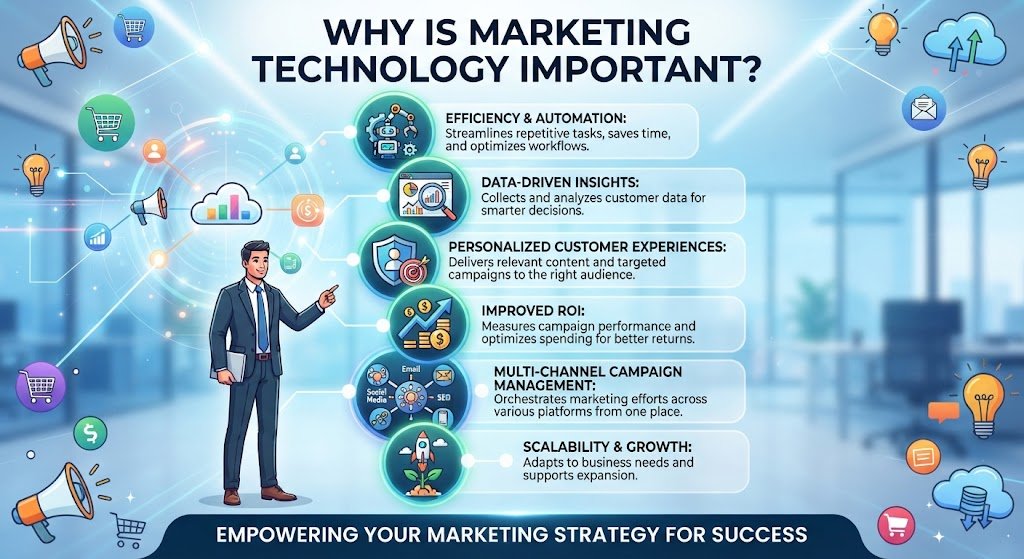
3. Why Is Marketing Technology Important?
Modern customers interact with businesses through many digital channels. They may discover a brand through Google, see its social media content, visit its website, subscribe to an email list, and eventually make a purchase.
Managing all these interactions manually can be difficult.
Marketing technology helps businesses organize these activities and create a smoother customer journey. It can automate repetitive tasks, provide useful reports, and help marketing teams understand what is working.
Another major advantage is personalization. Customers are more likely to respond to content that is relevant to their interests instead of receiving the same message as everyone else.
Businesses can also use technology to track campaign performance more accurately. Rather than guessing whether a campaign worked, marketers can examine measurable data and adjust their strategy.
4. Major Types of Marketing Technology
There are many categories of marketing technology, and businesses do not necessarily need every tool. The right combination depends on the company’s goals, audience, budget, and marketing strategy.
Customer Relationship Management
CRM software helps businesses manage customer and prospect information.
A CRM system can store contact details, track interactions, organize sales opportunities, and help teams understand customer relationships.

Marketing Automation
Automation tools can handle repetitive marketing tasks such as email sequences, lead nurturing, campaign triggers, and customer follow-ups.
Automation can save time while keeping communication consistent.
Social Media Technology
Social media platforms and management tools help businesses schedule posts, monitor engagement, analyze performance, and manage multiple social channels.
These tools can be particularly useful for businesses that publish content frequently.
Content Marketing Technology
Content tools help marketers plan, create, organize, publish, and measure content.
They may support blogs, videos, social media posts, landing pages, and other digital assets.
Email Marketing Technology
Email platforms help businesses build subscriber lists, create campaigns, segment audiences, and measure email performance.
Automation can also send messages based on customer actions, such as signing up for a newsletter or abandoning a shopping cart.
Analytics and Reporting
Analytics tools provide information about website visitors, traffic sources, conversions, engagement, and campaign performance.
This information is essential for making data-driven marketing decisions.

Advertising Technology
Advertising platforms help businesses create and manage paid campaigns across search engines, social networks, websites, and other digital channels.
They can provide targeting, budgeting, conversion tracking, and performance reporting.
5. Powerful Marketing Technology Solutions for Businesses
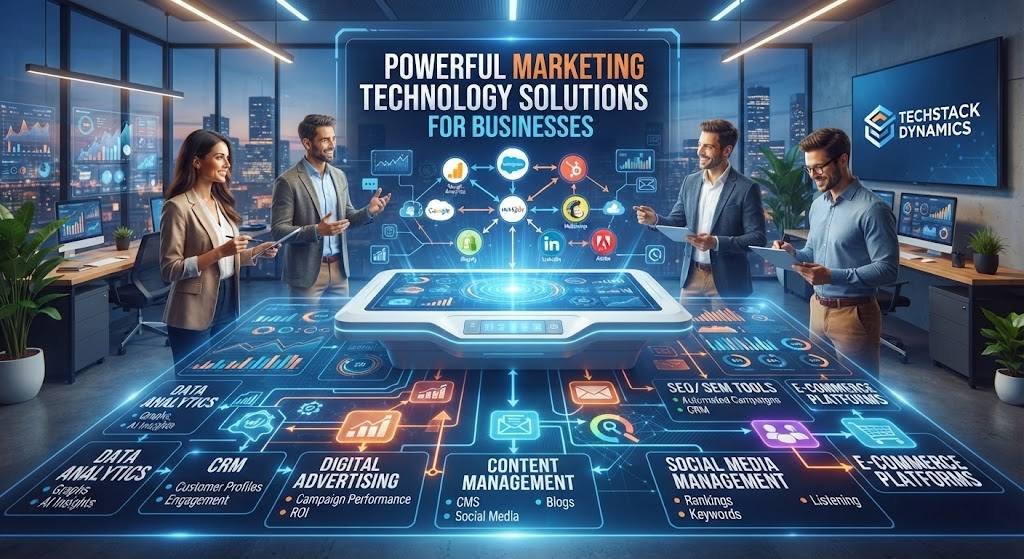
Different businesses need different solutions. A local restaurant may focus on social media, reviews, email marketing, and local search, while an online store may need advanced customer data, automation, advertising, and ecommerce analytics.
Common marketing technology solutions include:
- CRM software
- Email marketing platforms
- Marketing automation systems
- SEO tools
- Social media management software
- Customer data platforms
- Analytics systems
- Content management systems
- Advertising platforms
- AI-powered marketing tools
The best solution is not necessarily the platform with the largest number of features. Businesses should select technology that solves real problems and works well with their existing systems.
6. How Digital Technologies for Marketing Improve Customer Experience
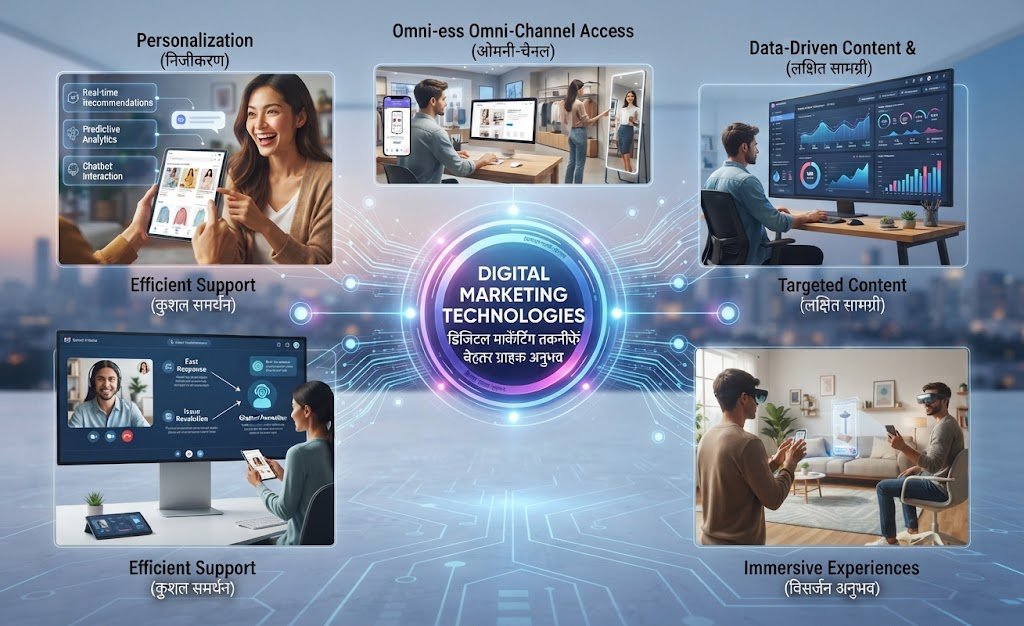
Customer experience has become a major part of modern business success. People expect fast communication, useful information, and relevant interactions.
Digital technologies for marketing can help businesses deliver these experiences across different channels.
For example, a company can use customer data to recommend relevant products, send personalized emails, provide helpful content, or respond quickly through automated chat systems.
Technology can also connect different customer touchpoints. A person might discover a product through social media and later receive an email containing more information about it.
When these systems work together, the customer journey can become more consistent and convenient.
7. The Role of Digital Analytics for Marketing
Data is one of the most valuable resources in modern marketing. However, collecting data is only useful when businesses can understand and apply it.
Digital analytics for marketing helps marketers examine customer behavior and campaign performance.
Important measurements may include:
- Website traffic
- Conversion rate
- Click-through rate
- Engagement
- Customer acquisition cost
- Return on investment
- Email performance
- Lead generation
- Sales
These measurements can reveal which channels are producing useful results and where improvements may be needed.
For example, if a campaign receives many clicks but very few conversions, the business may need to improve its landing page, offer, audience targeting, or messaging.
8. Marketing Technology and Artificial Intelligence
Artificial intelligence is becoming an important part of modern marketing.
AI can help marketers analyze large amounts of data, generate content ideas, personalize communication, answer customer questions, and identify patterns.
Businesses can also use AI-powered systems for customer segmentation, predictive analytics, chatbots, recommendations, and campaign optimization.
For content teams, AI can help with brainstorming, research organization, outlines, and repetitive tasks. Human review remains important because marketing content should be accurate, useful, original, and aligned with the brand.
As AI continues to develop, marketers will likely focus more on combining automation with human creativity and strategic thinking.

9. Marketing Technology for Social Media
Social media has become an important channel for building awareness and communicating with customers.
Businesses can use technology to schedule posts, monitor conversations, analyze engagement, and understand which types of content perform well.
For example, a digital marketing agency social media content ideas 2025 strategy may include short-form videos, educational posts, customer stories, product demonstrations, polls, behind-the-scenes content, and user-generated content.
Technology makes it easier to test different content formats and measure audience responses.
However, successful social media marketing is not only about publishing more content. Businesses should focus on content that provides value and matches the interests of their target audience.
10. Key Benefits of Marketing Technology
Using the right technology can provide several practical benefits.
Better Productivity
Automation reduces repetitive manual tasks and allows marketers to spend more time on strategy and creative work.
Improved Personalization
Customer data can help businesses deliver more relevant messages and offers.
Better Decision Making
Analytics provide measurable information that can support marketing decisions.
Stronger Customer Relationships
Organized customer information helps businesses communicate more consistently.
Easier Campaign Measurement
Marketers can track performance and identify which activities are generating results.
Scalable Marketing
Technology can help businesses manage larger audiences and more complex campaigns without increasing manual work at the same rate.

11. Common Challenges of Marketing Technology
Although technology offers many benefits, implementing too many tools can create new problems.
One common issue is tool overload. A marketing team may end up using several platforms that do not communicate properly with each other.
Data quality can also become a challenge. Inaccurate, duplicated, or outdated information can produce misleading reports.
Privacy and security are other important concerns. Businesses need to handle customer information responsibly and follow applicable privacy requirements.
There can also be training costs. Employees need time to understand new systems and use them correctly.
For these reasons, businesses should choose technology based on clear needs rather than simply collecting as many tools as possible.
12. How to Choose the Right Marketing Technology
Before investing in a new platform, businesses should identify the problem they want to solve.
Start by defining clear marketing goals. Then consider the following factors:
- Features
- Price
- Ease of use
- Integration options
- Scalability
- Analytics
- Security
- Customer support
- Automation capabilities
It is also useful to consider how the platform will fit into the existing technology stack.
A simple tool that employees actually use can be more practical than a complicated system filled with unused features.
13. Marketing Technology Companies and the Martech Ecosystem
There are many marketing technology companies offering specialized platforms for different parts of the customer journey.
Some focus on CRM systems, while others specialize in analytics, email marketing, advertising, content management, automation, or social media.
The Martech ecosystem continues to expand because businesses have increasingly complex digital marketing needs.
When comparing providers, businesses should focus on their specific requirements instead of choosing a platform simply because it is popular.
14. The Future of Marketing Technology
The future of marketing will likely involve greater automation, personalization, artificial intelligence, analytics, and connected customer experiences.
AI will continue to influence how marketers analyze data and create content. Predictive systems may help businesses identify customer behavior patterns before they become obvious.
Privacy will also remain important. As customers become more aware of how their information is collected and used, businesses will need responsible data practices.
Another major trend is the integration of marketing platforms. Instead of keeping customer information in disconnected systems, companies will increasingly look for ways to connect data and workflows.
The goal will not simply be to use more technology. It will be to use the right technology in ways that improve customer experiences and business results.
15. Marketing Technology Best Practices
Businesses can get more value from their technology investment by following a few practical principles.
First, start with clear goals. Technology should support a specific business or marketing objective.
Second, keep customer data organized and accurate.
Third, avoid unnecessary tools. A smaller, connected technology stack can be easier to manage.
Fourth, monitor important KPIs regularly.
Finally, continue training marketing teams. Even powerful technology is only useful when people understand how to use it effectively.
Frequently Asked Questions
What is marketing technology?
Marketing technology refers to software, digital tools, and platforms used to plan, execute, automate, and measure marketing activities.
What are examples of marketing technology?
Examples include CRM systems, email marketing platforms, analytics tools, social media software, advertising platforms, content management systems, and automation tools.
Why is marketing technology important?
It can help businesses automate repetitive tasks, understand customers, measure campaigns, personalize communication, and make data-driven decisions.
What are marketing technology solutions?
Marketing technology solutions are software platforms and digital systems designed to solve specific marketing needs, such as automation, analytics, customer management, advertising, or content creation.
How does AI affect marketing technology?
AI can support customer analysis, content creation, personalization, automation, predictive analytics, and customer service.
Conclusion
Marketing has become increasingly connected to technology, data, and automation. From CRM systems and email platforms to analytics, social media tools, and artificial intelligence, businesses now have many ways to improve their marketing processes.
The key is not to use every available tool. Instead, businesses should choose technology that supports their goals, improves customer experiences, and provides useful information for decision making.
When implemented thoughtfully, marketing technology can help marketing teams work more efficiently, understand their audiences better, and build stronger digital campaigns. As technology continues to evolve, businesses that focus on useful tools, responsible data practices, and genuine customer value can adapt more effectively to the changing digital landscape.