
Artificial intelligence is changing how people work, learn, communicate, and solve everyday problems. From virtual assistants and recommendation systems to self-driving technology and content creation tools, AI has become an important part of modern life. However, not every AI system works in the same way. Some systems perform specific tasks, while others represent more advanced forms of intelligence that researchers are still working to develop.
Understanding the types of artificial intelligence can help you learn how these technologies work, where they are used, and what they might achieve in the future. It can also help business owners, students, and technology enthusiasts make better decisions when exploring AI tools.
In this guide, we will explore the main categories of artificial intelligence, explain the difference between machine learning and AI, and examine the benefits, limitations, and future possibilities of this rapidly developing technology.
Table of Contents
What Are the Types of Artificial Intelligence?
Artificial intelligence, commonly known as AI, refers to computer systems designed to perform tasks that usually require human intelligence. These tasks may include understanding language, recognizing images, identifying patterns, making predictions, and generating content.
When discussing the types of artificial intelligence, experts commonly use two classification methods. The first is based on capabilities, which describes how broadly an AI system can perform intelligent tasks. The second is based on functionality, which describes how an AI system handles information and responds to situations.
These classifications help explain the differences between today’s practical AI applications and more advanced concepts that remain theoretical.
Modern AI also includes technologies such as machine learning, deep learning, and generative AI. Each technology serves different purposes, but they can work together to create useful applications for individuals and businesses.
3 Types of Artificial Intelligence Based on Capabilities
The capability-based classification includes Artificial Narrow Intelligence, Artificial General Intelligence, and Artificial Superintelligence. These categories describe different levels of potential intelligence.
1. Artificial Narrow Intelligence (ANI)
Artificial Narrow Intelligence, also called Narrow AI or Weak AI, is designed to perform specific tasks. It is the most common form of AI used in practical applications today.
Narrow AI can perform certain tasks very effectively, but it does not automatically possess general human-like intelligence. For example, an AI system trained to recognize faces cannot necessarily diagnose diseases or write computer programs without additional capabilities and training.
Examples of Artificial Narrow Intelligence include:
- Virtual assistants that respond to voice commands.
- Recommendation systems that suggest videos, products, or music.
- Email filters that identify potential spam.
- AI chatbots that answer customer questions.
- Image recognition systems used in security and healthcare.
Businesses use Narrow AI to automate repetitive tasks, analyze information, and improve customer experiences. Students may use AI tools to understand difficult concepts, summarize information, or organize their work.
Among the different types of artificial intelligence, Artificial Narrow Intelligence is the most widely used because it can perform specific tasks efficiently.
Although Narrow AI can be powerful within its intended purpose, its performance depends on the system’s design, training, available information, and operating conditions.

2. Artificial General Intelligence (AGI)
Artificial General Intelligence refers to a proposed form of AI that could learn, reason, and solve a broad range of problems across different fields, much like a human can.
Unlike Narrow AI, which is built for particular tasks, AGI would be able to transfer knowledge between different situations and adapt to unfamiliar problems without requiring a separate system for every task.
For example, a genuinely general AI might learn a new scientific concept, apply reasoning to a practical problem, and use that knowledge in another area.
However, AGI has not been established as an achieved technology. Current AI systems can perform many impressive tasks, but their capabilities and limitations differ from human intelligence.
Researchers continue to investigate how machines might achieve more general reasoning, reliable learning, and flexible problem-solving. Important challenges include understanding context, evaluating information, avoiding errors, and adapting safely to new situations.
Understanding the types of artificial intelligence helps explain why AGI differs from current AI systems and how it might develop in the future.

3. Artificial Superintelligence (ASI)
Artificial Superintelligence describes a hypothetical form of AI that would exceed human intellectual abilities across many or most important areas.
In theory, such a system might outperform humans in scientific research, strategic planning, complex problem-solving, and other intellectual activities.
However, ASI remains a theoretical concept rather than an established real-world technology. Its possible development raises questions about safety, control, accountability, and the effects of highly advanced automation on society.
Researchers and policymakers discuss these possibilities because future AI development may create opportunities as well as significant challenges.
For example, highly advanced AI could potentially help researchers explore difficult scientific questions. At the same time, ensuring that powerful systems remain controllable and aligned with human goals would be essential.
Understanding ASI therefore requires distinguishing between what AI systems can do today and what people imagine they might achieve in the future.

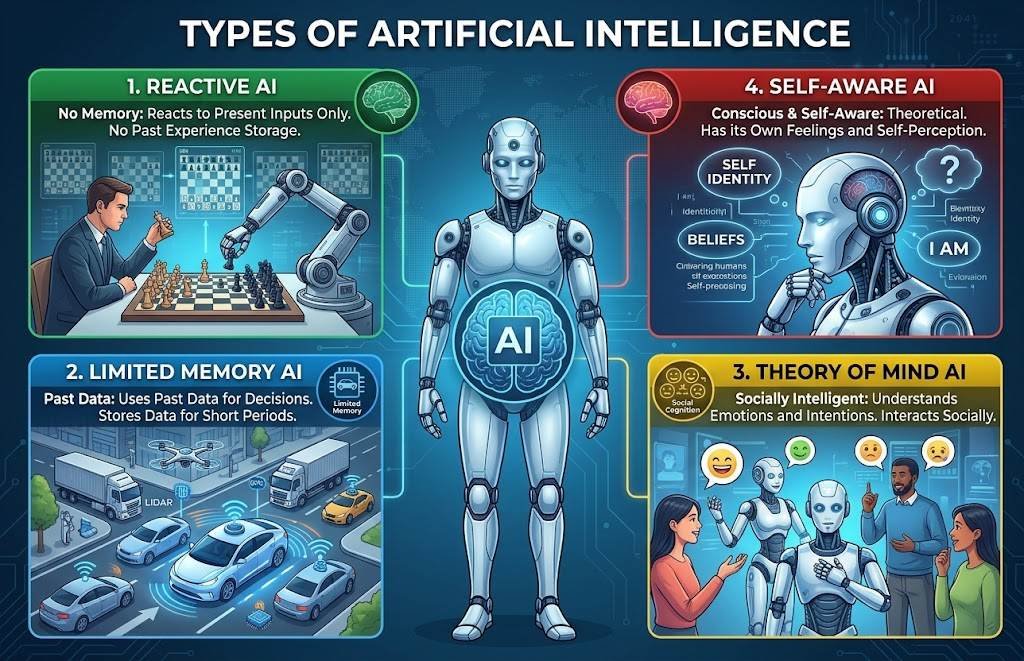
Types of Artificial Intelligence Based on Functionality
Another way to understand AI is to examine how systems process information and respond to their environment. This classification commonly includes reactive machines, limited memory, theory of mind, and self-aware AI.
4. Reactive Machines
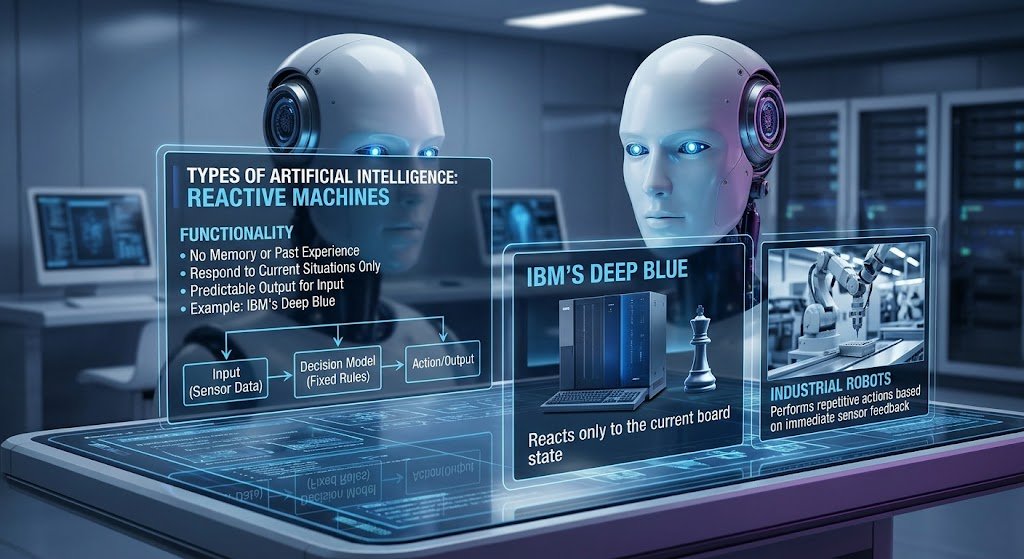
Reactive machines represent a basic conceptual category of artificial intelligence. These systems respond to current inputs without using stored personal experiences from previous situations to guide their decisions.
A classic example is IBM’s Deep Blue chess computer, which analyzed possible moves and selected strategies to compete against a human chess champion.
Reactive systems can be effective when their operating environment is clearly defined. They may evaluate available information and choose an appropriate response according to their programmed logic.
However, their limited ability to learn from previous interactions makes them unsuitable for tasks that require ongoing adaptation based on personal history.
Although the term is useful for understanding AI development, not every modern AI application fits neatly into a single functionality category.
5. Limited Memory AI
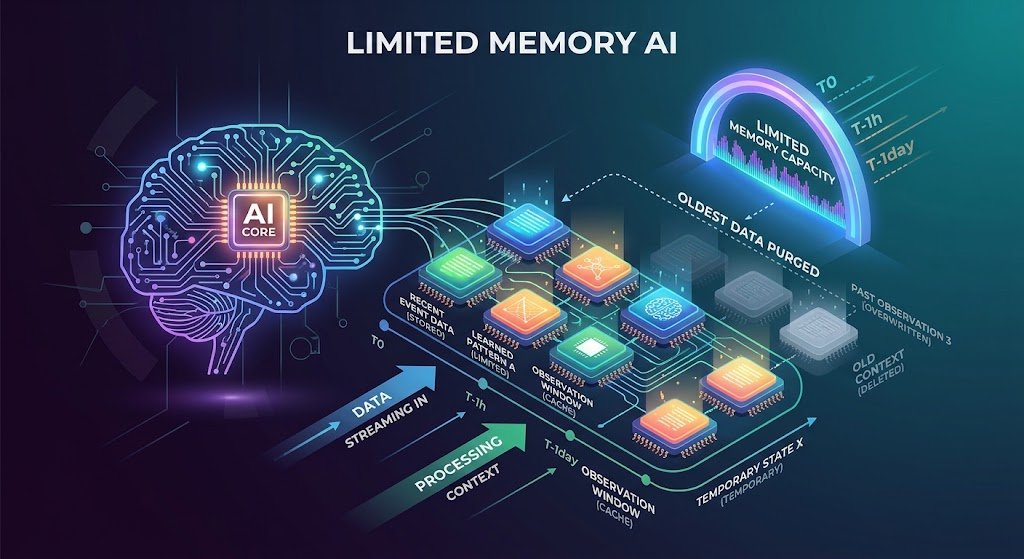
Limited Memory AI describes systems that use past information, observations, or learned patterns to help make decisions. Many modern AI applications rely on this general approach.
For example, a recommendation system may analyze previous user interactions to suggest relevant products or videos. A driver-assistance system may process recent information about nearby vehicles, road markings, and surrounding conditions.
Limited memory does not necessarily mean that a system remembers every interaction permanently. Information may be stored temporarily, retained in a database, or represented through patterns learned during training, depending on how the system is designed.
This category is important because modern AI applications frequently depend on historical data or recent observations to produce useful results.
However, these systems can still make mistakes when information is incomplete, conditions change, or the data contains bias.
6. Theory of Mind AI
Theory of Mind AI refers to a proposed type of AI that could recognize and reason about people’s beliefs, intentions, emotions, and social expectations.
Humans regularly use these abilities to understand conversations, predict reactions, and respond appropriately to other people. An AI system with stronger social reasoning might eventually support more natural interactions in education, healthcare, and customer service.
For example, an advanced assistant might recognize that a person is confused by an explanation and respond with simpler language.
Current AI tools can identify certain emotional cues or generate empathetic responses, but that does not prove they genuinely understand human emotions or possess a complete theory of mind.
Developing reliable social reasoning remains challenging because human behavior is complex and influenced by culture, experience, context, and individual differences.
7. Self-Aware AI
Self-aware AI is a hypothetical category describing machines that would possess genuine self-awareness or consciousness.
Such a system would involve more than recognizing its own technical status or describing its capabilities. The concept generally suggests an internal awareness of its own existence and mental states.
Scientists have not established that current AI systems possess this kind of consciousness. An AI chatbot may talk about feelings or describe itself, but producing such language is not evidence of subjective experience.
Self-aware AI remains a philosophical and scientific question rather than a demonstrated technological achievement.
Understanding this distinction is important when evaluating claims about advanced AI. A system’s ability to communicate naturally does not necessarily mean it thinks, feels, or experiences the world as a human does.
Machine Learning and Artificial Intelligence: What Is the Difference?
Machine learning and artificial intelligence are closely related, but they do not mean exactly the same thing.
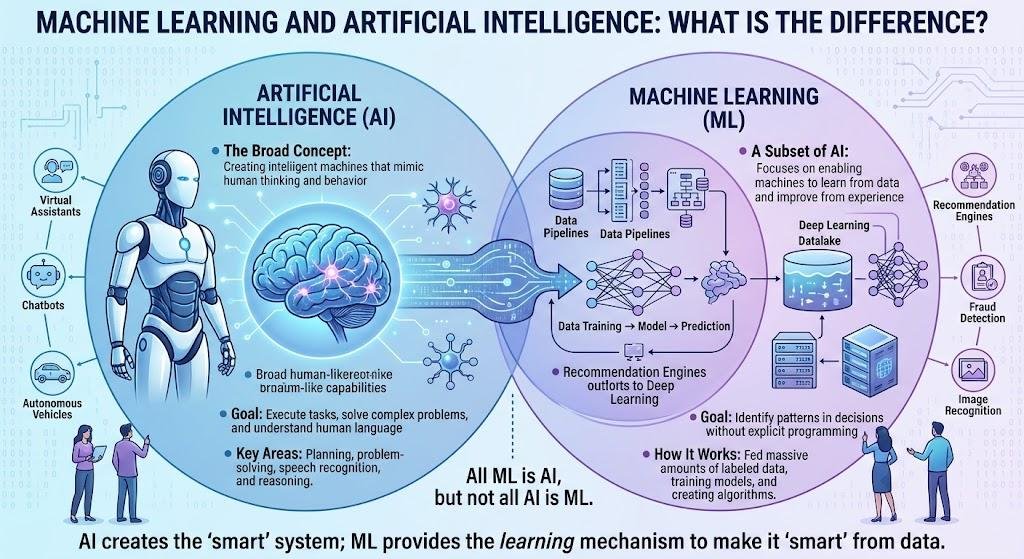
Artificial intelligence is the broader field of developing computer systems that perform tasks associated with human intelligence. These tasks include reasoning, language processing, pattern recognition, and decision support.
Machine learning (ML) is a subfield of AI that enables systems to learn patterns from data and use those patterns to make predictions or decisions.
For example, an email filter may learn to identify spam messages by analyzing examples of unwanted and legitimate emails. A product recommendation system may learn from user interactions to suggest items that a customer might like.
Deep learning is another subfield of machine learning that uses multi-layered neural networks to identify complex patterns in data.
What Is Machine Learning vs AI?
The main difference is scope. AI includes a wide range of approaches for creating intelligent behavior, while machine learning focuses on methods that learn from data.
Not every AI system must use machine learning. Some systems rely on predefined rules or search methods. Similarly, machine learning can be used for applications that do not necessarily require broad human-like reasoning.
Understanding this relationship helps readers evaluate technology claims and choose appropriate tools for specific tasks.
Other Important Types of AI Technology
Beyond the two major classification systems, several AI technologies are especially important in modern applications.
Generative AI
Generative AI creates new content based on patterns learned from training data. Depending on the system, it can generate text, images, audio, video, or computer code.
Businesses may use generative AI to brainstorm ideas, prepare draft documents, develop marketing materials, or support customer service. However, generated information should be checked because AI tools can produce inaccurate statements or misleading results.
Deep Learning
Deep learning uses neural networks with multiple processing layers to learn complex patterns. It supports many applications involving image recognition, speech processing, language understanding, and advanced data analysis.
Its performance often depends on suitable training data, computing resources, and careful evaluation.

Predictive AI
Predictive AI analyzes data to estimate likely future outcomes. Businesses may use it to forecast demand, identify unusual transactions, estimate equipment failures, or understand customer behavior.
Predictions are not guarantees. Their reliability depends on data quality, assumptions, and changes in real-world conditions.
Natural Language Processing
Natural Language Processing, or NLP, helps computers process and analyze human language. Applications include translation tools, search systems, text classification, and conversational assistants.
NLP is especially useful when organizations need to process large amounts of written or spoken information.
Real-World Applications of Artificial Intelligence
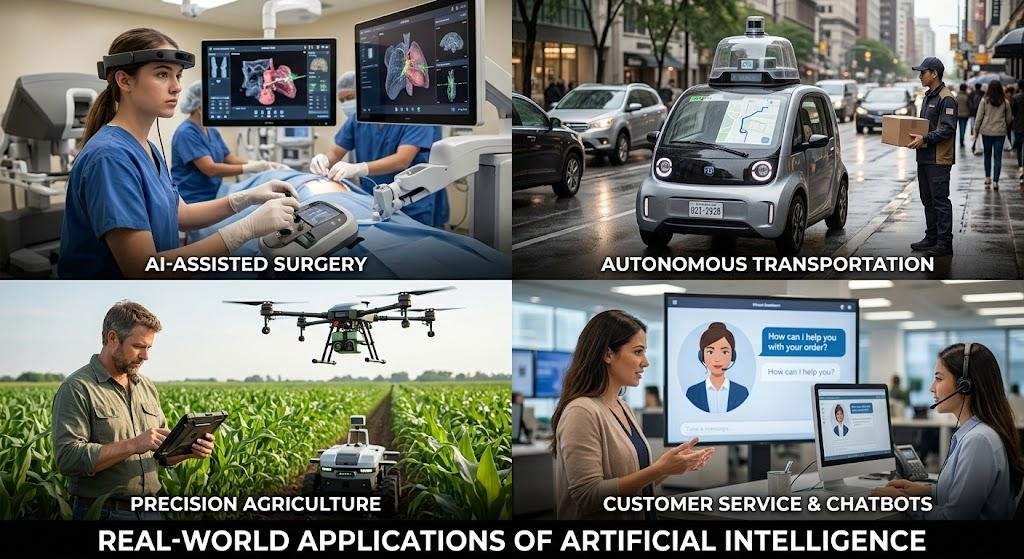
The types of artificial intelligence and related technologies have practical applications across many industries.
Healthcare: AI can assist with medical image analysis, research, administrative tasks, and clinical decision support. Medical professionals must evaluate results carefully.
Education: Learning platforms can provide personalized practice, explain difficult topics, and help teachers prepare educational materials.
Business and marketing: Companies use AI to analyze customer trends, automate repetitive tasks, draft content, and improve certain decision-making processes.
Transportation: Driver-assistance systems can detect obstacles, monitor road conditions, and support safer driving. Fully autonomous driving remains challenging in many environments.
Customer service: AI chatbots can answer routine questions, direct users to relevant resources, and assist support teams.
Cybersecurity: AI tools can help identify unusual activity, prioritize alerts, and detect possible security threats.
These examples show how AI can support human work. Its effectiveness depends on the quality of the technology, the task involved, and appropriate human oversight.
Different types of artificial intelligence support industries such as healthcare, education, transportation, cybersecurity, and customer service.
Future AI Technology: What Can We Expect?
Future AI technology may bring improvements in automation, scientific research, robotics, education, and business operations. Researchers are working to make AI systems more capable, efficient, reliable, and useful in different environments.
One possible development is the growth of AI assistants that can help people complete multi-step tasks. Other areas of research include systems that process text, images, audio, and video together, as well as robotics that can respond more effectively to changing environments.
Businesses will likely continue exploring AI for data analysis, customer support, product development, and workflow automation. Following reliable technology news sources, including The Rundown AI, can help readers keep up with industry developments. Specific reports should be checked against original announcements and independent evidence.
However, the future of AI will not depend on technical progress alone. Privacy, fairness, security, transparency, and accountability will remain important considerations.
Rather than assuming that every prediction will become reality, readers should evaluate future AI technology by examining demonstrated capabilities, research evidence, and practical limitations.
Benefits and Limitations of Different AI Types
Artificial intelligence offers several potential benefits. It can automate repetitive work, analyze large datasets, identify patterns, and help people complete tasks more efficiently. In some settings, it can also support accessibility by providing speech recognition, translation, and other useful services.
However, AI also has limitations. Systems can produce inaccurate information, reflect biases in their data, or perform poorly in unfamiliar situations. Some applications require expensive computing resources, specialized expertise, and ongoing maintenance.
Privacy and security are additional concerns, particularly when AI systems process personal or confidential information.
The best approach is to select technology according to the problem being solved. Human review, reliable data, clear objectives, and regular evaluation can help organizations use AI more responsibly.Choosing the right types of artificial intelligence depends on your goals, available data, and the specific problem you want to solve.
Frequently Asked Questions
1. What Are the Types of Artificial Intelligence?
AI is commonly classified by capabilities into Narrow AI, General AI, and Superintelligence. A separate functionality-based classification includes reactive machines, limited memory, theory of mind, and self-aware AI.
2. How Many Types of AI Are There?
There is no single universal number because AI can be classified in different ways. The two commonly discussed frameworks contain three capability-based categories and four functionality-based categories.
3. Which Type of AI Is Used Today?
Most practical AI applications are forms of Narrow AI. Examples include recommendation systems, spam filters, voice assistants, image recognition, and generative AI tools.
4. Is Machine Learning a Type of Artificial Intelligence?
Yes. Machine learning is a subfield of artificial intelligence that allows computer systems to learn patterns from data and use them to make predictions or decisions.
5. Will Artificial General Intelligence Be Developed in the Future?
It is uncertain when or whether AGI will be achieved. Researchers continue to explore more general learning and reasoning, but current systems still have important limitations.
Conclusion
Understanding the types of artificial intelligence makes it easier to see how today’s AI systems work and how future developments might change technology. Narrow AI already supports many everyday applications, while Artificial General Intelligence and Artificial Superintelligence remain concepts associated with more advanced capabilities.
Functional classifications, including reactive machines and limited memory systems, provide another way to understand how AI processes information. Meanwhile, machine learning, deep learning, generative AI, and natural language processing support many modern applications.
As AI technology continues to develop, learning about its benefits and limitations will help individuals and businesses make more informed decisions. The most useful approach is to focus on real capabilities, verify important information, and use AI responsibly.