
Generative AI has become a common part of modern technology. From writing emails to creating images and helping developers write code, it can perform many tasks that previously required a lot of human time and effort.
But an important question is: which task is a generative AI task?
The easiest way to understand it is to look at what the AI produces. Generative AI is designed to create new content based on instructions, data, or patterns it has learned. This content can include text, images, audio, video, software code, and other forms of digital material.
For example, asking an AI tool to write a product description is a generative AI task because the system creates new text. Similarly, asking it to create an image from a written description is also a generative task.
In this guide, I will explain how to identify generative AI tasks, share practical examples, discuss its benefits, and explain where it can be useful in business and software development.
Which Task Is a Generative AI Task?
A generative AI task is an activity where an AI system creates new content or information in response to a prompt or set of instructions.
For example, generating a blog introduction, creating a marketing image, writing computer code, or producing a video script can all involve generative AI.
The key point is that the system is not simply identifying or sorting existing information. Instead, it produces an output based on the information and patterns it has learned.
Some common generative tasks include:
- Writing an email
- Creating a product description
- Generating an article outline
- Creating an image from a prompt
- Writing or explaining computer code
- Creating a social media post
- Summarizing and rewriting information
- Producing a video or audio script
This makes generative AI especially useful for creative and content-based work.

What Makes a Task Suitable for Generative AI?
Not every AI task is a generative task. A simple way to identify one is to ask whether the system needs to create something new.
Creating New Content
Writing is one of the most common uses. An AI tool can create an email, report, story, product description, or social media caption from a short instruction.
Transforming Existing Content
Generative AI can also change information into a different format. For example, it can turn a long report into a short summary or rewrite technical information in simpler language.

Generating Ideas
Another useful application is brainstorming. Businesses can ask AI for product ideas, advertising concepts, article topics, or possible solutions to a problem.
Creating Code
Developers can use generative AI to create code from natural-language instructions. It can also explain existing code and suggest possible improvements.
What Would Be an Appropriate Task for Using Generative AI?
A good task for generative AI is usually one that involves creating, rewriting, summarizing, or transforming content.
For example, a marketing team could ask AI to create five different versions of an advertisement. A writer could use it to develop an article outline. A developer could ask it to generate a basic code example.
Other suitable tasks include:
- Creating customer email drafts
- Generating product descriptions
- Brainstorming content ideas
- Writing meeting summaries
- Creating presentation outlines
- Generating marketing copy
- Translating and rewriting content
- Creating programming examples
However, AI-generated information should still be reviewed by a person, especially when accuracy is important.

Examples of Generative AI Tasks
Generative AI can work with several types of content.
Text Generation
Text generation is one of the most familiar applications. AI can produce:
- Blog outlines
- Emails
- Reports
- Product descriptions
- Social media posts
- Scripts
- FAQs
A person provides instructions, and the AI creates text that matches the requested purpose and style.
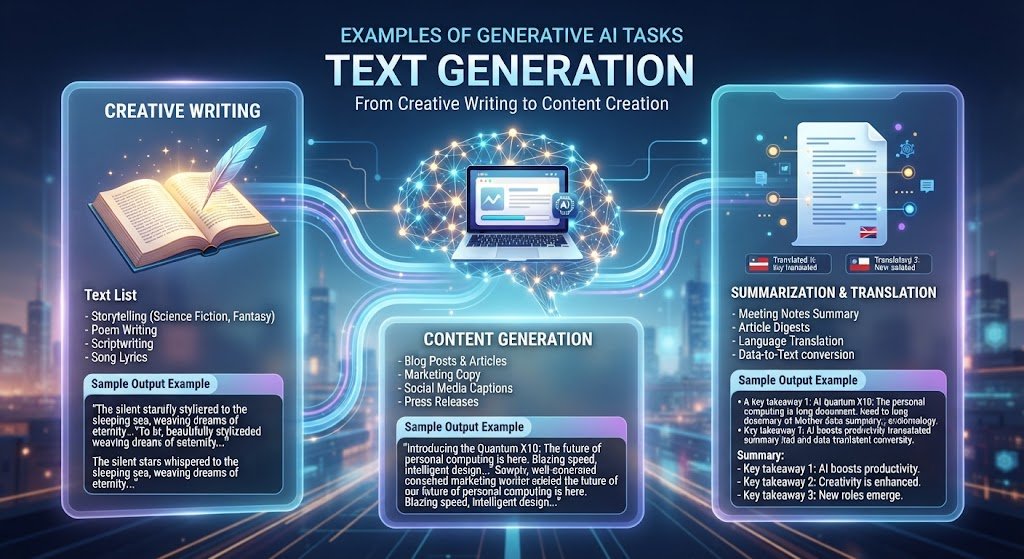
Image Generation
Generative AI can create images from text descriptions. A user might describe a product scene, illustration, advertisement concept, or creative design, and the system can generate an image based on that description.
This can help designers and marketing teams develop ideas more quickly.
Code Generation
AI can also generate programming code. A developer can describe what a program should do, and an AI system can provide a possible implementation.
It can be useful for simple functions, examples, documentation, testing ideas, and learning programming concepts.
Audio and Video Content
Generative systems can also help create voice content, scripts, music concepts, and video material. These applications are becoming increasingly useful for education, marketing, entertainment, and online publishing.
Generative AI Software Development
Generative AI software development refers to using generative AI technologies as part of the software development process.
Developers can use AI to help with several activities, including writing code, explaining functions, generating documentation, creating test cases, and finding possible errors.
For example, instead of starting a small programming function from scratch, a developer can describe the required result and ask an AI tool for a starting point.
Generative AI can also help developers understand unfamiliar code. This can be useful when working with older projects or large software systems.
However, AI-generated code should not automatically be considered correct. Developers should test, review, and secure the code before using it in production.

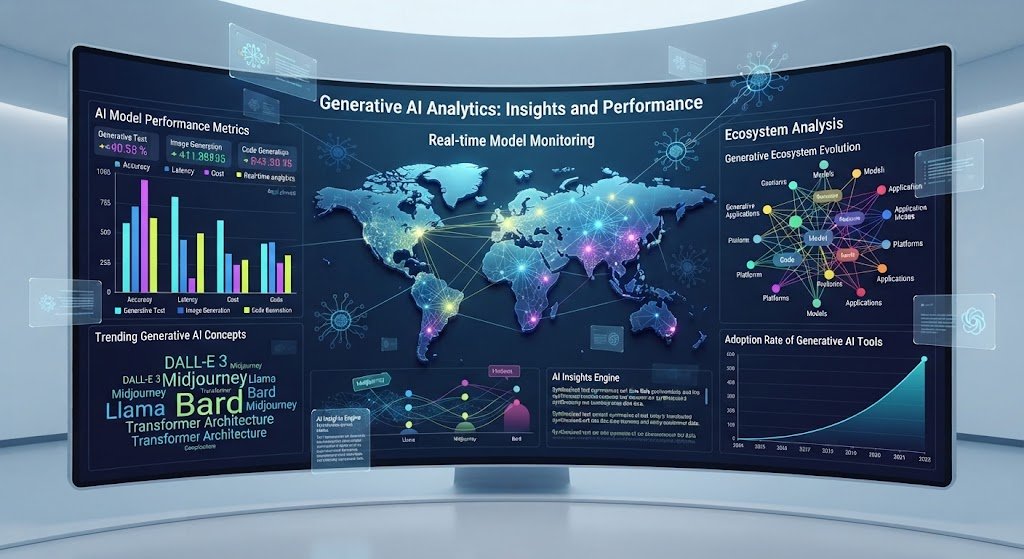
Generative AI Analytics
Generative AI analytics combines data analysis with natural-language generation. Instead of requiring users to study every number in a large report, an AI system can help explain patterns and produce easier-to-read summaries.
For example, a business might use AI to summarize sales data and highlight changes between different periods.
Generative AI can help with:
- Creating data summaries
- Explaining trends
- Producing business reports
- Generating natural-language insights
- Turning complex information into simpler explanations
It is important to remember that AI-generated analysis still needs verification. Incorrect or incomplete data can lead to incorrect conclusions.
What Are the Benefits of Generative AI?
There are several generative AI benefits for individuals and organizations.
Saves Time
AI can complete many first-draft tasks quickly. Instead of starting from an empty page, users can begin with an AI-generated draft and then improve it.
Supports Productivity
Generative AI can help with repetitive content work, research assistance, documentation, and other everyday activities.
Encourages Creativity
AI can provide multiple ideas when someone is stuck. Writers, designers, marketers, and developers can use these ideas as starting points.
Helps With Personalization
Businesses can create different versions of content for different audiences. This can make communication more relevant.
Supports Developers
AI coding assistants can help developers write examples, explain code, and create documentation.
Simplifies Complex Information
Generative AI can explain technical or complicated information in simpler language, which can help people learn new subjects.
Generative AI vs Traditional AI
Generative AI and traditional AI can both be useful, but they often perform different types of tasks.
| Generative AI | Traditional AI |
| Creates new content | Often classifies or predicts |
| Generates text, images, audio, or code | Detects patterns in existing data |
| Produces responses from prompts | Often produces a defined result |
| Useful for creative tasks | Useful for classification and prediction |
| Can create multiple possible outputs | Often follows a specific objective |
For example, creating an article with AI is generative, while identifying whether an email is spam is generally a classification task.
The difference is mainly about what the system is being asked to produce.

Which Tasks Are Not Generative AI Tasks?
It is also useful to understand what does not normally count as a generative AI task.
For example, a system that only determines whether a credit-card transaction is fraudulent is performing a prediction or classification task.
Other examples include:
- Detecting spam emails
- Identifying objects in an image
- Predicting a numerical value
- Checking whether a transaction is suspicious
- Classifying documents into categories
These tasks can use artificial intelligence, but they do not necessarily involve generating new content.
Generative AI in Business
Businesses are using generative AI across many departments. Marketing teams can create content drafts, customer service teams can prepare responses, and developers can receive assistance with coding tasks.
It can also support internal documentation and business reporting.
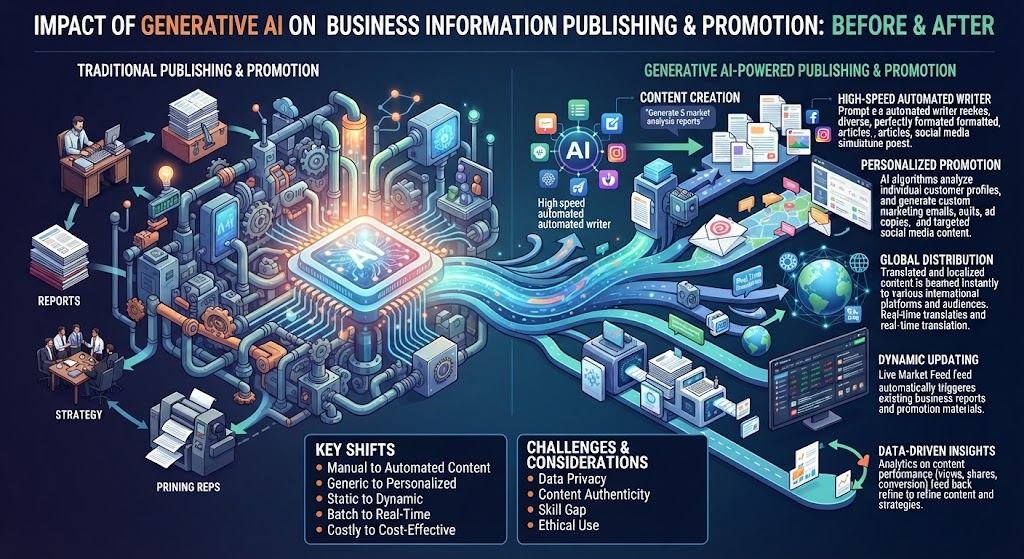
Impact of Generative AI on Business Information Publishing and Promotion
The impact of generative AI on business information publishing and promotion can be significant because organizations can create and adapt content more quickly.
For example, a business can use AI to develop a first draft of a product description and then have a human editor improve it. Marketing teams can also create different versions of a message for different platforms.
However, businesses should focus on accuracy, originality, brand voice, privacy, and human review rather than publishing AI-generated material without checking it.
How to Choose the Right Task for Generative AI
Before using generative AI, ask a few simple questions:
- Does the task require creating new content?
- Can the desired result be clearly explained?
- Can a person review the final output?
- Will AI save meaningful time?
- Does the task involve sensitive information?
If the task requires new content and can be reviewed properly, generative AI may be a useful option.
For sensitive business, financial, legal, or personal information, organizations should also consider their privacy and security requirements before entering data into an AI system.
Free AI Agent Classes and Learning Resources
People who want to learn more about AI can explore beginner-friendly educational resources and courses. Search terms such as free AI agent class from Google RuralBytes Tamil may lead learners toward resources focused on AI agents and related technologies.
AI agents are different from simple generative AI prompts because agents can be designed to perform multiple steps toward a goal. Generative AI can often provide the content or reasoning that supports those steps.
For beginners, it is useful to first understand basic generative AI concepts before moving into more advanced AI agent workflows.
Common Mistakes When Using Generative AI
Generative AI can be useful, but it should not replace human judgment in every situation.
Common mistakes include:
- Trusting every AI-generated statement
- Publishing content without reviewing it
- Giving AI sensitive information unnecessarily
- Ignoring copyright and originality concerns
- Using AI for tasks that require professional judgment
- Assuming generated code is automatically secure
- Failing to verify important facts
The best approach is usually to treat AI output as a starting point that needs appropriate human review.
Frequently Asked Questions
Which task is a generative AI task?
A task is generally generative when an AI system creates new content such as text, images, audio, video, or computer code from instructions or learned patterns.
What would be an appropriate task for using generative AI?
Writing drafts, generating ideas, summarizing information, creating images, producing code examples, and rewriting content are common appropriate tasks.
Is writing code a generative AI task?
Yes. When an AI system creates new computer code from a user’s instructions, it is performing a generative AI task.
What are the main benefits of generative AI?
Common benefits include saving time, supporting creativity, improving productivity, creating content, and helping users work with complex information.
Can generative AI analyze data?
Yes. Generative AI can help summarize and explain data, but important business decisions should be based on verified data and appropriate human analysis.
Final Thoughts
So, which task is a generative AI task? The clearest answer is any task where AI is asked to create new content or transform information into a new useful form.
Writing an email, generating an image, creating code, developing ideas, and producing a report can all involve generative AI. Its value comes from helping people complete creative and repetitive tasks more efficiently.
At the same time, good results depend on clear instructions, quality data, and human review. When used thoughtfully, generative AI can become a practical tool for content creation, software development, analytics, business communication, and many other areas of modern technology.