
Artificial intelligence has become one of the most important technologies in the modern world. From smartphones and online shopping to healthcare and education, AI is changing how people work, communicate, and solve everyday problems. Many people use AI-powered tools without even realizing how much technology is working behind them.
But what does AI stand for, and why has it become such an important part of modern life? AI stands for Artificial Intelligence, a field of computer science that focuses on developing machines and software capable of performing tasks that normally require human intelligence. These tasks include learning, understanding language, recognizing images, solving problems, and making predictions.
Today, artificial intelligence is no longer limited to science fiction or advanced research laboratories. It is available through everyday applications, smart devices, and online services. Understanding its meaning, purpose, benefits, and limitations can help people make better decisions when using this technology.
Learning what does AI stand for also helps beginners understand the growing role of artificial intelligence in everyday technology.Understanding what does AI stand for provides a clearer picture of how modern computer systems perform intelligent tasks.
Table of Contents
1. What Does AI Stand For?
AI stands for Artificial Intelligence. The term describes computer systems designed to perform tasks that usually require human thinking or intelligence. These systems can process information, identify patterns, respond to questions, and complete different activities based on their programming and training.
The word “artificial” means something created by humans, while “intelligence” refers to the ability to learn, understand, and solve problems. Together, Artificial Intelligence describes technology that imitates certain aspects of human intelligence.
For example, when someone asks a digital assistant about the weather, the system can understand the question and provide a relevant answer. Similarly, an AI-powered translation application can convert sentences from one language into another within seconds.
Understanding what AI stands for is the first step toward learning how this technology works and why businesses, governments, and individuals are increasingly interested in it.
2. What Is the Definition of Artificial Intelligence?
The definition of artificial intelligence refers to computer systems and machines that can perform tasks associated with human intelligence. These tasks may involve learning from information, recognizing patterns, understanding language, and making decisions.
Traditional computer programs usually follow specific instructions written by developers. AI systems can go further by identifying patterns in training data and using those patterns to produce predictions, recommendations, or responses.
For example, an email service can recognize messages that look like spam. Instead of requiring users to identify every unwanted message manually, its AI-powered system analyzes different characteristics and helps move suspicious emails into a separate folder.
Artificial intelligence does not necessarily mean that a machine thinks or feels like a human. Most existing AI systems are designed for particular tasks and operate within specific limitations.
This distinction is important because AI can produce impressive results without having human emotions, personal experiences, or genuine awareness.When people ask what does AI stand for, they are usually looking for a simple explanation of how intelligent computer systems work.

3. What Is the Main Purpose of AI?
The main purpose of artificial intelligence is to develop systems that can perform useful tasks more efficiently, support human decisions, and solve problems using available information.
AI is designed to make certain activities faster and easier. It can process large amounts of data, recognize patterns, automate repetitive work, and help people understand complicated information.
Some important purposes of AI include:
- Automating repetitive tasks: AI can handle routine activities such as organizing information, sorting documents, and responding to common customer questions.
- Improving productivity: Employees can use AI tools to prepare drafts, summarize information, and complete certain tasks more quickly.
- Supporting decision-making: AI systems can analyze information and identify patterns that may help individuals and organizations make informed decisions.
- Solving complex problems: Researchers use AI to study large datasets and explore solutions in areas such as medicine, science, and engineering.
- Improving user experiences: Recommendation systems can suggest products, movies, music, and other content based on user activity.Understanding what does AI stand for makes it easier to recognize how this technology supports people in different industries.
Many articles about the purpose of AI explain how this technology supports human abilities rather than simply replacing human workers. Its greatest value often comes from combining machine processing with human knowledge, judgment, and creativity.Knowing what does AI stand for also helps businesses understand how artificial intelligence can improve productivity and support better decision-making.

4. How Does Artificial Intelligence Work?
Artificial intelligence works by processing information through algorithms and computational models. Depending on the system, it may learn patterns from training data and use those patterns to generate predictions, classifications, or responses.
Although different AI applications work in different ways, most follow a few basic steps.
Data Collection: AI systems need information to learn patterns. This information may include text, images, videos, numbers, or other digital content.
Data Processing: The collected information is organized and prepared so that the system can analyze it.
Training: During training, an AI model adjusts its internal parameters to recognize patterns and improve its performance on a particular task.
Testing: Developers evaluate the model using information that was not included in its training process. This helps them understand how accurately it performs.
Output Generation: After training, the system can respond to new information by producing an answer, recommendation, prediction, or other result.
For example, an image recognition system can examine thousands of labeled photographs during training. Later, it may identify similar objects in a new picture.
However, AI does not always provide correct answers. Its performance depends on the quality of its data, design, training, and the way people use it.

5. What Are the Main Types of Artificial Intelligence?
Artificial intelligence can be classified in different ways. One common theoretical classification divides AI into three categories based on its capabilities.
Narrow AI (Weak AI)
Narrow AI is designed to perform specific tasks. It is the type of artificial intelligence widely used today.
Examples include voice assistants, recommendation systems, facial recognition software, and spam filters.
These systems can perform certain activities effectively but generally cannot transfer their abilities to every other task like a human.
Artificial General Intelligence (AGI)
Artificial General Intelligence refers to a theoretical form of AI that could understand, learn, and perform a wide range of intellectual tasks at a level comparable to humans.
Unlike narrow AI, AGI would not be limited to one specific function. However, genuine human-level general intelligence remains an unachieved research goal.
Artificial Superintelligence (ASI)
Artificial Superintelligence describes a hypothetical system that would exceed human intellectual abilities across many areas, including scientific reasoning, creativity, and problem-solving.
ASI remains a theoretical concept rather than an existing technology.
Understanding these categories helps readers distinguish between the AI applications available today and possible developments that researchers discuss for the future.
6. What Are the Most Common Uses of AI?
Artificial intelligence is used across many industries because it can process information and automate selected activities. Its applications continue to expand as organizations discover new ways to use this technology.
Here are some common examples.
Healthcare: Medical professionals use AI-powered systems to analyze medical images, organize patient information, and support certain diagnostic processes. These tools can assist healthcare workers, but medical decisions still require qualified professionals.
Education: Students and teachers use AI applications for explanations, language support, research assistance, and personalized learning activities.
Business: Companies use AI to analyze customer behavior, manage information, improve customer service, and automate repetitive office tasks.
Transportation: AI supports navigation applications, traffic analysis, driver assistance systems, and route planning.
Entertainment: Streaming platforms use recommendation systems to suggest movies, television shows, and music based on viewing or listening patterns.
Customer Service: AI-powered chatbots can answer common questions, provide basic support, and help customers find information.
These examples show that AI is not limited to technology companies. It has become a useful tool in many areas of everyday life.Knowing what does AI stand for can help users better understand the technology behind these everyday applications.

7. Why Has AI Become So Popular?
Artificial intelligence has become popular because it is now more accessible, powerful, and practical than it was in the past.
Several technological developments have contributed to its rapid growth.
Better Computing Power: Modern computers and specialized processors can perform complex calculations much faster than older systems.
Large Amounts of Data: Digital platforms generate enormous quantities of information. This data helps researchers and developers train different AI models.
Improved Algorithms: Advances in machine learning and deep learning have made it possible to develop systems that can recognize complex patterns and generate useful results.
Easy Access to AI Tools: People can now access AI through websites, mobile applications, and software they already use.
Business Demand: Organizations are increasingly interested in automation, productivity improvements, and data analysis.
Generative AI has also attracted attention because it allows users to create written content, images, summaries, and other materials through simple instructions.
As a result, people no longer need advanced programming knowledge to experience many AI capabilities.

8. What Are the Benefits of Using AI?
Using AI can provide several advantages when the technology is applied appropriately. It can help individuals, businesses, and organizations complete certain tasks more efficiently.
Some important benefits include:
1. Saves Time: AI can perform repetitive activities quickly, allowing people to focus on more important responsibilities.
2. Improves Productivity: Businesses can use automation tools to manage routine work and organize information.
3. Analyzes Large Datasets: AI systems can examine large quantities of information and identify patterns that may be difficult to notice manually.
4. Provides Personalized Recommendations: Online platforms can suggest products, music, and educational resources based on user preferences.
5. Supports Research: Researchers can use AI tools to organize information, explore patterns, and assist with scientific investigations.
6. Improves Accessibility: Speech recognition, text-to-speech, and translation tools can help people communicate and access digital information.
However, these benefits are not automatic. AI systems must be selected, tested, and monitored carefully to produce reliable results.

9. What Are the Risks and Disadvantages of AI?
Despite its advantages, artificial intelligence also creates challenges that individuals and organizations should understand.
One major concern is data privacy. Some AI applications process personal or sensitive information, so users need to understand how their data is collected, stored, and used.
Another concern is inaccurate information. Generative AI tools can sometimes produce convincing answers that contain incorrect facts. Users should verify important information instead of accepting every response without checking.
Other disadvantages include:
- Job Displacement: Automation may reduce the need for workers in certain repetitive roles, although it can also create new types of employment.
- Bias: AI systems can produce unfair results when their training data contains existing biases.
- Security Risks: Criminals may misuse AI for scams, impersonation, and misleading content.
- High Development Costs: Building and maintaining advanced AI systems can require expensive equipment and technical expertise.
- Overdependence: Excessive reliance on AI may reduce opportunities to develop independent problem-solving and critical-thinking skills.
Understanding these limitations makes it easier to use AI responsibly and recognize situations where human judgment is essential.
10. What Is Responsible AI Governance?
Responsible AI governance refers to the policies, practices, and processes organizations use to develop and manage artificial intelligence safely and fairly.
As AI becomes more common, businesses and governments need clear rules to ensure that these systems are used appropriately.
An effective governance approach generally focuses on several important areas.
Transparency: People should understand when AI is being used and how important decisions are influenced by automated systems.
Accountability: Organizations should identify who is responsible for developing, monitoring, and managing their AI applications.
Privacy Protection: Personal information must be handled carefully, with appropriate security measures and data protection practices.
Fairness: AI systems should be evaluated for potential bias to reduce unfair treatment of different individuals or groups.
Human Oversight: Important decisions should receive appropriate human review, particularly in areas such as healthcare, finance, and employment.
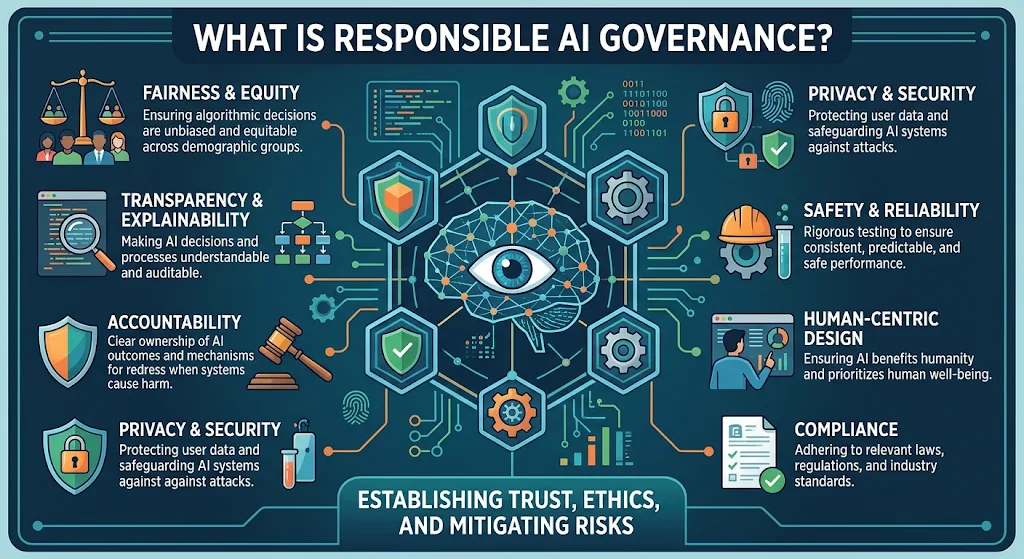
Organizations may also use responsible AI governance framework design patterns to establish consistent processes for identifying risks, reviewing systems, and managing their development.
For example, a company introducing an AI-powered hiring system should test whether its recommendations unfairly disadvantage certain applicants. It should also provide human oversight and clear procedures for reviewing decisions.
Responsible governance helps build trust and encourages the development of AI systems that serve people more effectively.
11. What Is the Future of Artificial Intelligence?
The future of artificial intelligence is expected to bring new opportunities across technology, education, healthcare, transportation, and business.
AI tools may become more integrated into everyday software and digital devices. People could use more advanced assistants to organize schedules, understand information, manage tasks, and communicate across different languages.
In healthcare, researchers may continue exploring how AI can support medical imaging, scientific research, and the development of new treatments.
In education, intelligent learning platforms may provide more personalized explanations and help students understand difficult subjects.
Businesses may also introduce more automation to improve customer support, analyze information, and manage everyday operations.
However, future progress will depend on more than technical improvements. Privacy protection, security, transparency, responsible development, and human supervision will remain important.
AI should be viewed as a tool that supports human capabilities rather than a replacement for every form of human knowledge and judgment.Understanding what does AI stand for will become increasingly valuable as artificial intelligence continues to influence future technologies.
Frequently Asked Questions About Artificial Intelligence
1. What Does AI Stand For in Simple Words?
AI stands for Artificial Intelligence. It refers to computer systems and machines designed to perform tasks that normally require human intelligence, such as learning, recognizing patterns, and solving problems.People searching for what does AI stand for should remember that AI refers to machines performing tasks that normally require human intelligence.
2. Who Invented Artificial Intelligence?
Artificial intelligence developed through the contributions of many researchers. John McCarthy is widely recognized for introducing the term Artificial Intelligence in 1956 and helping establish AI as an academic research field.
3. Is AI the Same as Machine Learning?
No. Artificial intelligence is the broader field of developing intelligent computer systems, while machine learning is a part of AI that allows systems to learn patterns from data.
4. What Is the Main Purpose of AI?
The main purpose of AI is to help machines perform useful tasks, automate selected activities, analyze information, and support human problem-solving and decision-making.
5. Can AI Think Like a Human?
Current AI systems can perform tasks that appear intelligent, but this does not mean they think, feel, or understand experiences in the same way humans do.
6. What Are Some Examples of AI in Everyday Life?
Common examples include voice assistants, email spam filters, navigation applications, online shopping recommendations, translation tools, and AI chatbots.
7. Why Has AI Become So Popular?
AI has become popular because of improved computing power, better algorithms, large datasets, accessible applications, and growing demand for automation and productivity.
Conclusion
Artificial intelligence has become an important part of modern technology, influencing how people learn, communicate, work, and solve problems. Understanding what AI stands for helps beginners explore this growing field and recognize its practical applications.
Understanding what does AI stand for is a useful starting point for anyone interested in learning about modern technology.
AI offers many benefits, including improved productivity, faster information processing, automation, and personalized services. However, it also introduces challenges involving privacy, security, fairness, and inaccurate information.
The best approach is to use AI as a supportive technology while maintaining human judgment and responsibility. As artificial intelligence continues to develop, understanding its capabilities and limitations will help people make smarter decisions and prepare for a technology-driven future.