
Drone technology is changing how businesses inspect buildings, monitor crops, collect information, and respond to emergencies. What once required a human pilot controlling every movement can now be handled through automated flight plans, intelligent software, and advanced sensors. These developments are making drone technology more useful across many industries.
Autonomous drones are designed to complete specific flying tasks with limited direct human control. Depending on their capabilities, they can follow planned routes, collect aerial images, detect obstacles, and return to a designated location. Some systems also use artificial intelligence (AI) to understand their surroundings and respond to changing conditions.
From agriculture and construction to security and environmental research, this technology offers practical benefits. However, it also introduces challenges involving safety, privacy, battery life, and government regulations.
In this guide, you will learn how these drones work, explore nine important benefits, discover their major applications, and understand the technology’s future potential.
Table of Contents
What Are Autonomous Drones?
Autonomous drones are unmanned aircraft that can perform certain flight operations with limited or no continuous input from a human pilot. They use a combination of software, sensors, navigation systems, and onboard computers to complete assigned tasks.
For example, a drone might follow a planned route across a farm, capture images of crops, and return to its starting point. Another might inspect a construction site and collect photographs from predetermined positions.
However, autonomy comes in different levels. Some drones simply follow pre-programmed routes, while more advanced systems can adjust their movements according to sensor information. A fully autonomous system is not necessarily capable of handling every situation independently.
Human supervision remains important, particularly when flights take place near people, buildings, roads, or restricted airspace.

How Do Autonomous Drones Work?
Understanding the underlying technology helps explain why these aircraft are becoming increasingly useful.
Artificial Intelligence and Machine Learning
AI drones can process information from cameras and other sensors to recognize objects, identify patterns, and support navigation decisions. For example, computer vision software may help a drone recognize trees, buildings, or obstacles along its route.
Machine learning can also help analyze collected information. In agriculture, software may identify areas that require closer inspection. In infrastructure projects, image analysis can help teams locate visible damage.
Not every drone needs artificial intelligence to fly automatically. Basic automation can follow predetermined instructions without advanced AI.

GPS, Sensors, and Navigation
Global Positioning System (GPS) technology helps many drones determine their location and follow planned routes. Cameras, inertial measurement units, and other sensors can provide additional information about movement and surroundings.
Obstacle-detection systems may use cameras, radar, lidar, or other technologies to identify objects in a drone’s path. Their effectiveness depends on the equipment, software, lighting, weather, and operating environment.
Automated Flight Planning
Operators can create flight plans that specify routes, altitudes, observation points, and return locations. The drone’s software then manages the planned flight within its technical limits and permitted operating conditions.
More advanced systems may adjust their routes when they encounter obstacles or changing conditions. Nevertheless, automated flight planning does not eliminate the need for proper preparation, supervision, and emergency procedures.
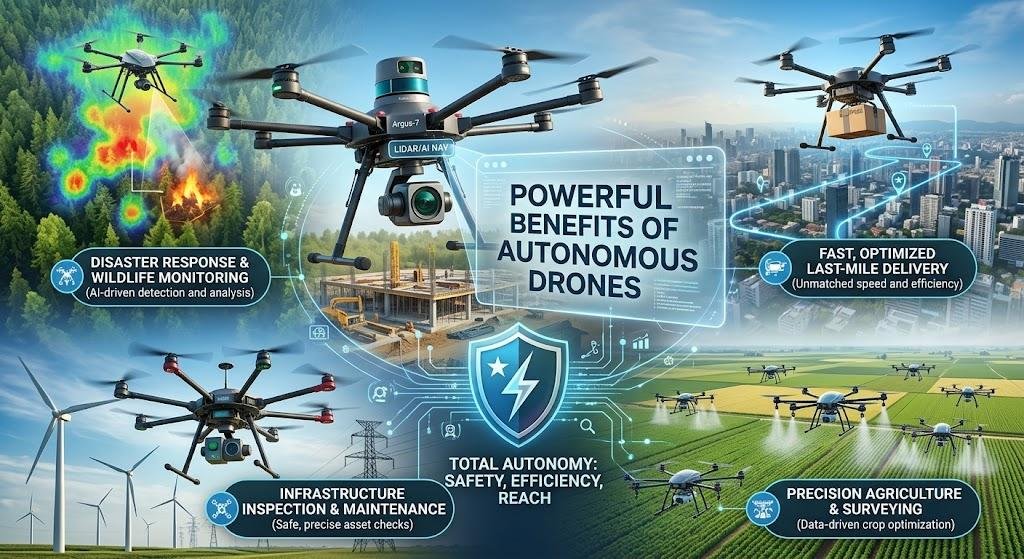
9 Powerful Benefits of Autonomous Drones
The following benefits explain why organizations are exploring drone automation for commercial and professional tasks.
1. Improved Efficiency and Productivity
Automated flight can reduce the time required to complete repetitive aerial tasks. Instead of manually controlling every movement, an operator can prepare a suitable route and let the drone collect information according to the plan.
This approach is particularly useful for surveying large properties, inspecting industrial facilities, and monitoring agricultural land.
2. Enhanced Workplace Safety
Some inspections involve difficult or dangerous environments, including tall structures, remote locations, and areas affected by natural disasters.
Drones can collect information without requiring workers to access every location physically. This can reduce certain workplace risks, although operators must still consider flight hazards and equipment limitations.
3. More Consistent Data Collection
Drones equipped with cameras and specialized sensors can collect aerial images from repeatable positions. This makes it easier to compare information from different dates and identify changes.
Construction managers, researchers, and agricultural professionals can use these records to support planning and decision-making.
4. Potential Operating Cost Savings
Automated flights may reduce labor requirements for repetitive inspections and help organizations cover large areas efficiently. They can also reduce the need for certain equipment, vehicles, or access arrangements.
However, savings are not guaranteed. Purchase costs, software subscriptions, insurance, maintenance, training, and regulatory compliance must all be considered.
5. Faster Infrastructure Inspections
Bridges, power lines, roofs, and industrial facilities often require regular inspection. Drones can capture images of difficult-to-reach areas and help inspectors identify locations that need closer examination.
They do not automatically replace qualified engineers. Instead, their collected information can support professional assessments and help teams plan maintenance more effectively.
6. Better Agricultural Monitoring
Farmers can use drones to survey fields, examine crop development, and identify areas that may need attention. Depending on the sensors and software, aerial data can help reveal differences in vegetation health or irrigation conditions.
These insights may support better decisions about water use, fertilizer application, and crop management. Actual results depend on data quality and appropriate interpretation.
7. Environmental Monitoring
Researchers can use aerial platforms to study forests, coastlines, wetlands, and wildlife habitats. Repeated surveys can help them observe environmental changes without entering every part of a research area.
Careful flight planning is essential because drone noise and movement can disturb wildlife, particularly in sensitive habitats.
8. Support for Emergency Response
During floods, wildfires, and other emergencies, drones can help responders assess affected areas and identify possible access routes.
Thermal cameras and other specialized equipment may support search-and-rescue operations under suitable conditions. These aircraft can provide valuable information, but weather, smoke, battery limitations, and communication problems can restrict their effectiveness.

9. Scalable Operations
Organizations with recurring aerial tasks may coordinate several drones to cover different locations or perform separate assignments.
Such operations require reliable planning, communication, monitoring, and procedures for handling failures. Using more aircraft does not automatically improve productivity unless the entire operation is carefully managed.
Different Types of Autonomous Drones
Drone designs vary according to flight requirements, payload capacity, operating environment, and intended use.
Multirotor Drones
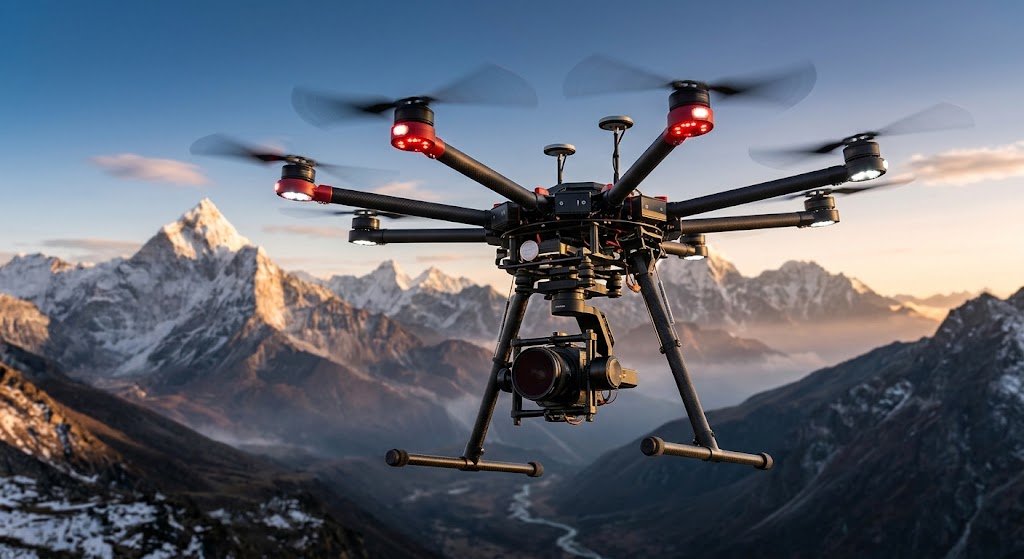
Multirotor drones use several rotating propellers to generate lift. They can hover, change direction quickly, and operate in relatively confined areas.
These characteristics make them suitable for roof inspections, photography, construction monitoring, and certain security applications. Their flight duration is often limited by battery capacity and payload weight.
Fixed-Wing Drones
Fixed-wing drones generate lift through their wings, similar to conventional airplanes. They are often suitable for covering large areas because many designs offer greater endurance than comparable multirotor aircraft.
They are commonly considered for agricultural mapping, land surveys, and environmental monitoring. However, some models require a runway or launch mechanism, and their ability to hover is limited.
Hybrid VTOL Drones
Hybrid vertical takeoff and landing (VTOL) designs combine vertical takeoff and landing with forward flight. This can provide greater flexibility when operating in locations without conventional runways.
Their suitability depends on endurance, payload requirements, operating conditions, and the complexity of the system.
AI-Powered Drone Systems
AI-powered drones use intelligent software to support tasks such as object recognition, route adjustment, and image analysis.
The level of independence varies significantly between products. Buyers should check whether a particular system genuinely supports autonomous navigation or simply offers automated features that still require frequent operator input.
Major Applications of Autonomous Drones
Agriculture and Precision Farming
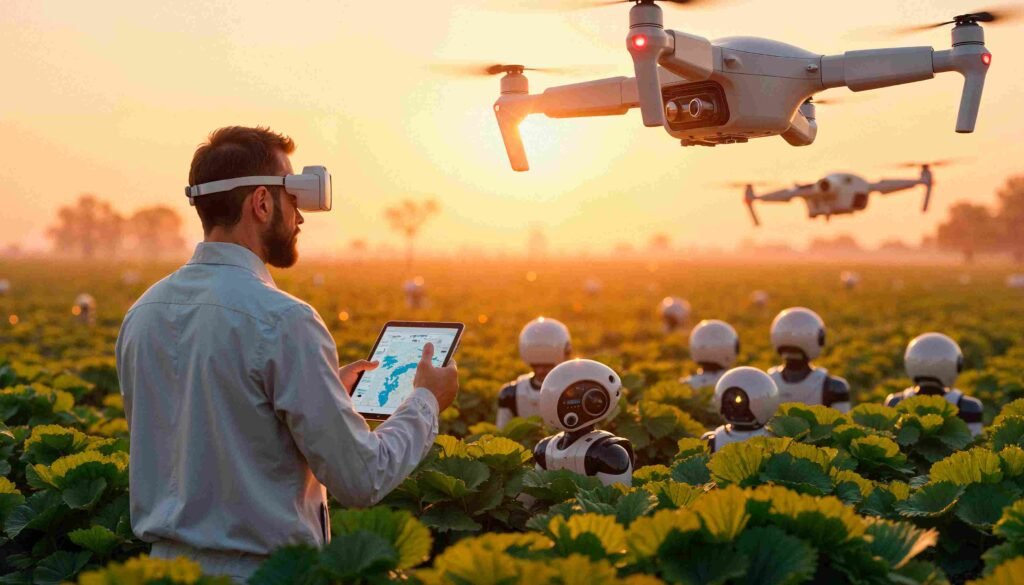
Agricultural businesses can use aerial surveys to monitor crops, assess field conditions, and create maps. These capabilities can help farmers identify areas that require further investigation.
Delivery and Logistics
Drone delivery may help transport selected packages, medical supplies, and other lightweight items. Commercial operations depend on payload limits, weather, airspace rules, and approved operating procedures.
Construction and Infrastructure
Construction teams can collect aerial images, measure site changes, and monitor project progress. Repeated flights can make it easier to compare current conditions with earlier records.
Autonomous Security Drones
Autonomous security drones can support scheduled patrols, perimeter monitoring, and alerts at selected facilities. They may help security teams investigate activity without immediately sending personnel to every location.
However, security operators must address privacy, data storage, restricted areas, and human oversight. Automated alerts can be inaccurate, so important decisions should not rely blindly on software.
Environmental Research
Researchers can use drones to map landscapes, monitor vegetation, and observe environmental changes. Appropriate flight practices help protect wildlife and reduce unnecessary disturbance.
Autonomous Drones vs. Traditional Drones
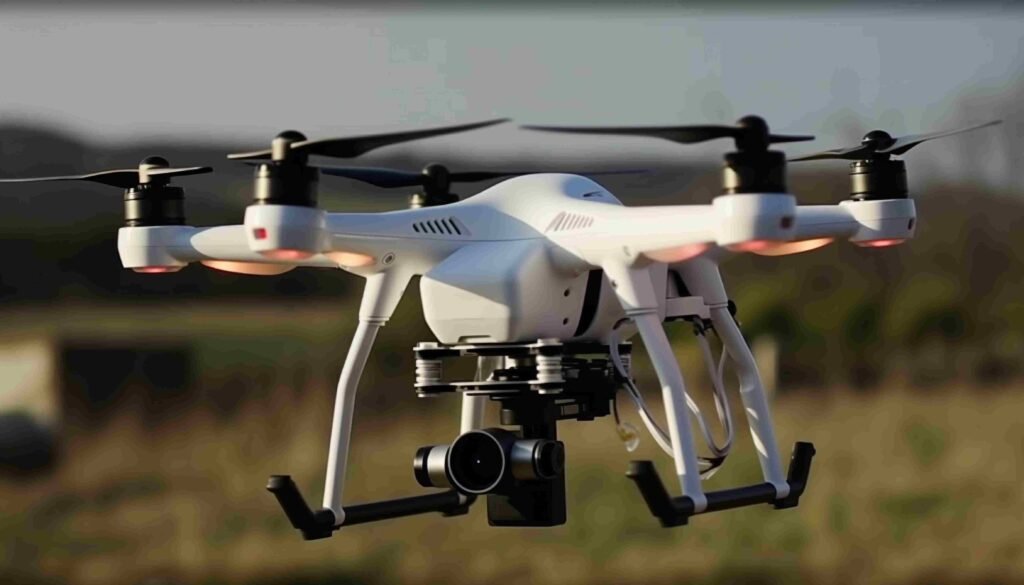
Traditional remote-controlled drones generally depend on a pilot to direct their movements. Some include assisted flight features, such as altitude holding or automated return-to-home functions.
By comparison, autonomous systems can complete selected tasks using programmed instructions and onboard information.
The main difference is the level of independent operation, not simply whether the drone contains AI. A drone that follows a predetermined route may operate autonomously for that task without being capable of independently solving unexpected problems.
Both types require responsible operation. The best choice depends on the user’s experience, budget, flight environment, and intended application.
Challenges and Limitations to Consider
Despite their benefits, these systems have several limitations.
Battery life and range: Flight time depends on battery capacity, payload, wind, temperature, and flight conditions. Long-distance operations require careful planning.
Safety and reliability: Sensor errors, software problems, and communication interruptions can affect performance. Operators need suitable emergency procedures.
Privacy and data security: Cameras may collect sensitive information. Organizations should establish clear rules for recording, storage, access, and deletion.
Regulatory compliance: Registration, pilot qualifications, operating permissions, and airspace restrictions vary by jurisdiction and operation. Always check the applicable aviation authority’s requirements before flying.
Initial investment: Equipment, maintenance, software, training, insurance, and repairs can increase the total cost of ownership.
Understanding these limitations helps businesses determine whether drone automation is appropriate for their needs.
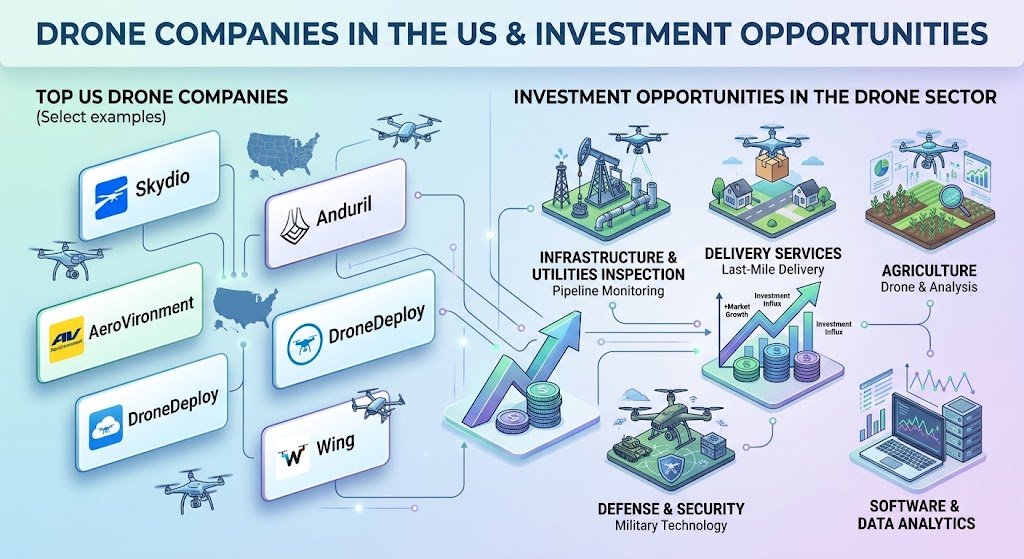
Drone Companies in the US and Investment Opportunities
The United States has businesses working across drone manufacturing, flight software, navigation systems, sensors, and commercial drone services. These companies serve different markets, so their products and financial performance can vary considerably.
Anyone researching drone companies in the US should distinguish between businesses focused primarily on drones and larger companies that earn revenue from multiple industries. Product quality, commercial demand, competition, regulatory requirements, and financial stability all deserve attention.
Investors searching for the best drone stocks to buy 2026 should conduct independent research rather than relying on promotional rankings. Examine revenue growth, profitability, cash flow, valuation, debt, and the company’s exposure to commercial or government customers.
A company involved in drone technology is not automatically a good investment. Stock prices can fluctuate, businesses can underperform, and future growth is never guaranteed. This information is educational and is not personalized financial advice.
What Is the Future of Autonomous Drones?
Future developments may improve onboard processing, navigation, battery performance, and the ability to interpret sensor information. Better software could help drones perform more complex inspections and operate more efficiently in suitable environments.
Commercial applications may expand in agriculture, infrastructure maintenance, environmental research, and logistics. Organizations may also develop improved methods for coordinating multiple aircraft.
However, widespread adoption will depend on more than technological progress. Reliable equipment, clear regulations, cybersecurity, public trust, and trained operators will remain essential.
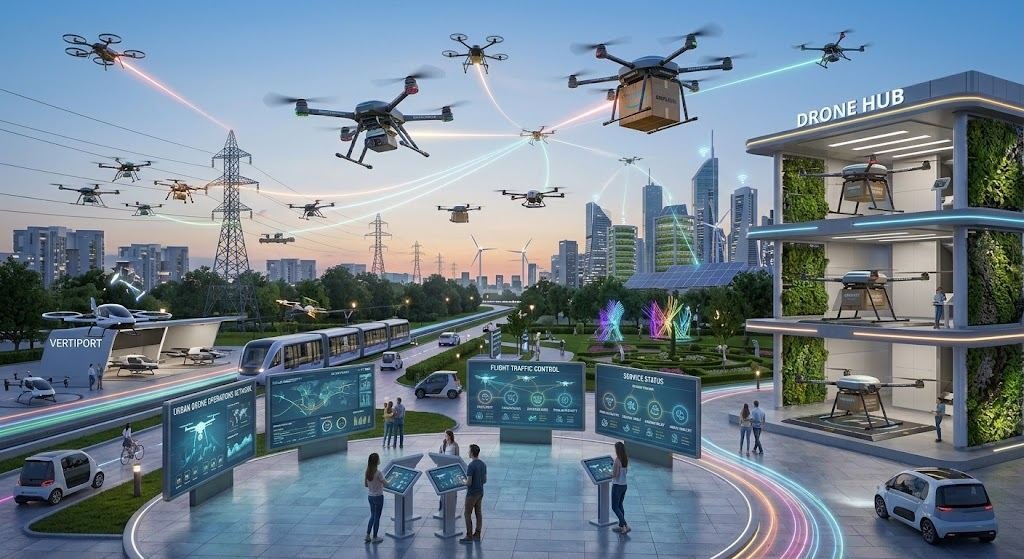
The most successful systems will be those that solve real problems safely and provide measurable value.
Frequently Asked Questions
What is an autonomous drone?
It is an unmanned aircraft that can complete certain flight tasks with limited direct pilot input, using programmed instructions, sensors, and navigation software.
Are AI drones and autonomous drones the same?
Not necessarily. AI can help a drone interpret information and make decisions, while autonomy describes its ability to perform tasks independently. Some autonomous drones use little or no advanced AI.
What are fixed-wing drones used for?
They are often used for mapping, surveying, agriculture, and environmental monitoring because many models can cover large areas efficiently.
Are autonomous security drones effective?
They can support perimeter monitoring and scheduled patrols, but effectiveness depends on sensor quality, operating conditions, system reliability, and appropriate human oversight.
Can drones operate without GPS?
Some drones can use alternative navigation technologies, including visual positioning and inertial sensors. Their performance depends on the system and surrounding environment.
Are autonomous drones worth the investment?
They may be worthwhile for organizations with frequent, repetitive aerial tasks. Buyers should compare expected benefits with purchase costs, maintenance, training, and regulatory obligations.
Conclusion
Drone automation is creating new possibilities for businesses, researchers, and public safety teams. From agricultural surveys to infrastructure inspections, these aircraft can improve efficiency, collect useful data, and reduce the need for people to access certain difficult locations.
However, the right solution depends on the task. Battery life, reliability, privacy, operating costs, and aviation regulations must all be considered before adopting a new system.
By understanding the technology and its limitations, organizations can make better decisions about where automated flight provides genuine value. As AI and navigation systems continue to develop, responsible implementation will be essential to the industry’s long-term success.