
Artificial Intelligence (AI) has become a part of everyday life, even when we do not always notice it. From search engines and voice assistants to online shopping and content tools, AI is helping people complete tasks faster and make better use of information.
When I first started learning about artificial intelligence, I found many explanations too technical. There were many terms about algorithms, models, data, and machine learning, but the basic idea was much easier to understand. AI is mainly about creating computer systems that can perform tasks that normally need human intelligence.
In this guide, I will explain artificial intelligence in simple words, how it works, its main functions, common uses, benefits, limitations, and what I think is important to know about its future.
What Is Artificial Intelligence?
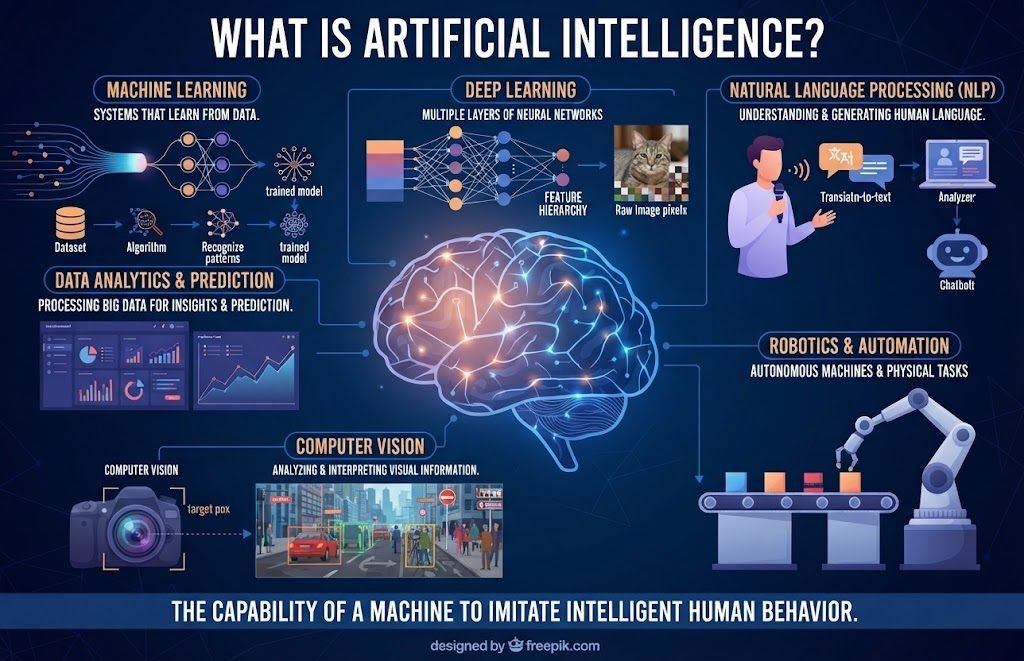
Artificial intelligence is a technology that allows computers and software to perform tasks that usually require human thinking. These tasks can include learning from information, understanding language, recognizing images, finding patterns, solving problems, and making predictions.
A simple example is a recommendation system. When I watch videos online, the platform may suggest other videos based on what I have watched before. AI can study patterns in user behavior and use those patterns to provide recommendations.
AI does not think exactly like a human. Instead, it uses data, rules, models, and computing power to produce an output. Some AI systems are designed for one specific job, while newer systems can handle many different types of tasks.
Intelligenz Definition: What Does Intelligence Mean?
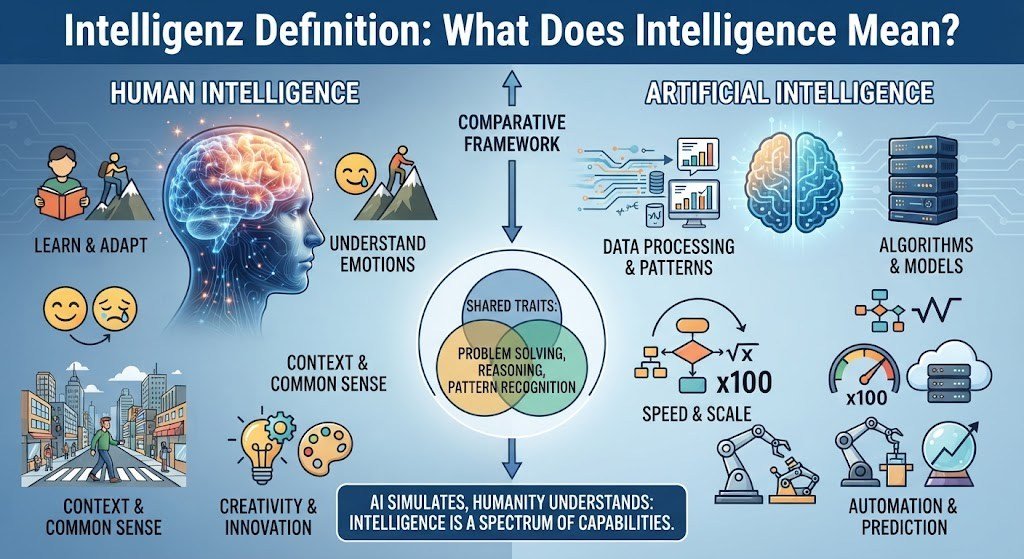
The phrase intelligenz definition refers to the meaning or definition of intelligence. In simple terms, intelligence is the ability to learn, understand information, solve problems, and use knowledge to make decisions.
Human intelligence is broad and flexible. People can learn from personal experiences, understand emotions, use common sense, and adapt to completely new situations.
AI tries to copy some parts of these abilities through computer systems. For example, an AI model can learn patterns from large amounts of data and then use those patterns to answer questions or make predictions.
This is one reason AI is useful in many fields. However, it is important to remember that artificial intelligence and human intelligence are not the same thing.
How Does Artificial Intelligence Work?
The way AI works can look complicated, but the basic process can be explained quite simply.
Data Collection
Data is one of the most important parts of modern AI. Data can include text, numbers, images, audio, video, or other information.
For example, an AI system designed to recognize pictures needs many examples to learn what different objects look like. The quality and amount of data can affect how well the system performs.
Machine Learning
Machine learning is an important part of AI. Instead of giving a computer a fixed answer for every possible situation, developers can train a model using data.
The model looks for patterns in that data. After training, it can use what it learned to make predictions or produce an answer when it receives new information.
For example, a machine learning system can study many examples of emails and learn patterns associated with spam messages.
Algorithms and Models
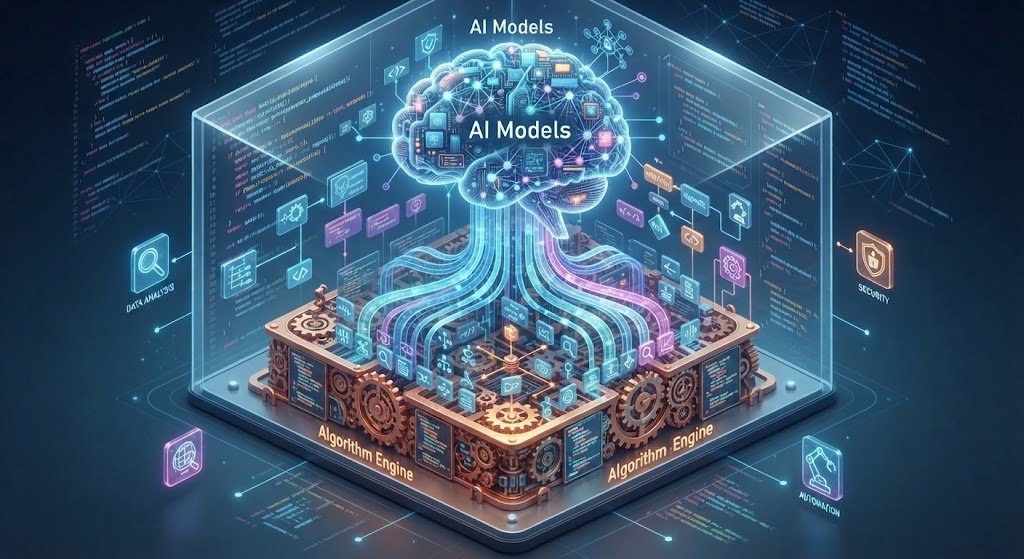
Algorithms are sets of instructions or methods used to process information and solve problems. AI models use these methods to find patterns and generate results.
The model is trained using data, and its performance can be tested using new data. Developers can then improve the system based on the results.
Generative AI
Generative AI is another important area of artificial intelligence. These systems can create new content such as text, images, audio, video, or computer code.
I find this part of AI especially interesting because it has changed how many people work with technology. Instead of only searching for information, users can now ask AI tools to create a draft, explain an idea, summarize information, or help with a task.
Main AI Functions
There are several important ai functions that explain what artificial intelligence can do.
One major function is learning. AI systems can learn patterns from data during training.
Another function is reasoning and problem-solving. Some AI systems can process information and use it to reach an answer or recommendation.
Language understanding is also important. AI can process human language and respond to questions, translate text, summarize documents, and generate written content.
AI can also recognize patterns in images, sounds, and other data. For example, computer vision systems can identify objects in images, while speech systems can convert spoken words into text.
Prediction is another common function. AI can study past information and use patterns to estimate what may happen next.
Automation is also a major reason businesses use AI. Repetitive tasks that once required a lot of manual work can sometimes be handled by software.
What Is a Software Framework for AI?
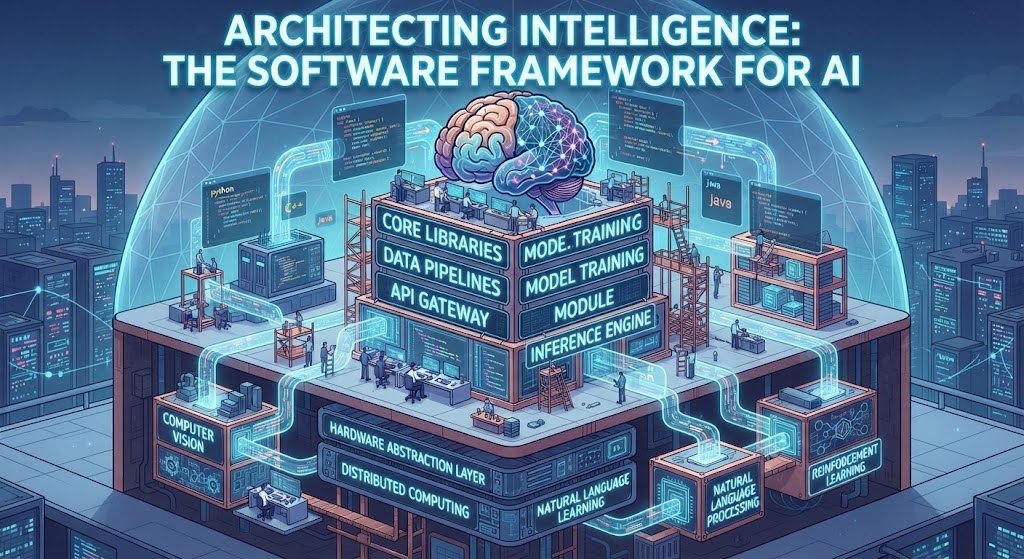
If you are wondering what is a software framework for ai, the simple answer is that it is a collection of tools and libraries that helps developers build AI and machine learning applications.
Creating an AI system from the beginning can take a lot of time. Frameworks give developers ready-made tools and functions that make development easier.
Some well-known AI and machine learning frameworks include TensorFlow, PyTorch, and Scikit-learn. Each has different features and is useful for different types of projects.
For someone learning AI, understanding frameworks can be useful because they connect AI concepts with real software development. Developers can use them to train models, test systems, process data, and build applications.
Types of Artificial Intelligence
Artificial intelligence can be discussed in several categories.
Narrow AI
Narrow AI is designed to perform a specific task or group of related tasks. Most AI systems we use today fall into this category.
Examples include recommendation systems, voice recognition tools, fraud detection systems, and image recognition software.
General AI
Artificial General Intelligence, often called AGI, refers to a theoretical type of AI that could perform a wide range of intellectual tasks at a human-like level.
AGI is different from the specialized AI tools commonly available today. It remains an area of research and discussion rather than something people commonly use as a fully developed technology.
Super AI
Super AI is a theoretical idea involving AI that would go beyond human abilities across many areas of intelligence. It is mainly discussed as a future concept rather than a current everyday technology.
Understanding these categories helps avoid confusion between what AI can actually do today and ideas about possible future systems.
Common Applications of Artificial Intelligence
Artificial intelligence is now used in many areas of life and business.
Healthcare
AI can help healthcare professionals analyze medical information, identify patterns, and support certain types of research. It can also be used in medical imaging and administrative work.
AI does not replace professional medical judgment. Instead, it can provide tools that support people who are responsible for making important decisions.
Education
Students can use AI tools for explanations, brainstorming, language practice, and study support. Teachers can also use AI for certain administrative and content-related tasks.
I believe the most useful approach is to use AI as a learning assistant rather than simply copying its answers.

Banking and Finance
Financial organizations use AI for fraud detection, risk analysis, customer support, and other data-heavy tasks.
Because financial information can be sensitive, security and privacy are especially important in this area.
E-Commerce
Online stores use AI to understand customer behavior and provide product recommendations. AI can also support customer service, search, inventory planning, and personalized experiences.
Transportation
AI can help with route planning, traffic prediction, navigation, and other transportation systems.
Customer Service
Many companies use AI-powered chat systems to answer common questions. These systems can work at any time and handle many simple requests without human involvement.
Content Creation
AI tools can help create drafts, ideas, summaries, images, and other forms of content. From my experience with online content, I see AI as a useful support tool, but human editing is still important.
Benefits of Artificial Intelligence
There are several reasons why businesses and individuals are interested in AI.
One major benefit is speed. Computers can process large amounts of information much faster than people can manually review it.
AI can also automate repetitive tasks. This gives people more time to focus on work that needs creativity, communication, or personal judgment.
Another benefit is consistency. A properly designed system can perform the same type of task repeatedly without getting tired.
AI can also help people find patterns in large datasets. This can be useful when there is too much information for a person to review manually.
Personalization is another advantage. Recommendation systems can use information about user behavior to provide more relevant results.

Challenges and Limitations of AI
AI also has important limitations. It is not a perfect technology.
One major problem is that AI can produce incorrect information. An answer may sound confident while still being wrong. This is why important information should be checked before it is used.
Data quality is another concern. If the data used to train or operate a system is incomplete or contains problems, the results can also be affected.
Privacy is important as well. AI systems may process large amounts of information, so organizations need to handle data responsibly.
Bias can also become a problem. If training data contains unfair patterns, an AI system may reproduce those patterns.
There are also concerns about jobs and automation. Some tasks may become more automated as AI improves, while new types of work may also develop around AI systems.
For these reasons, I think learning how AI works and understanding its limitations is just as important as learning how to use it.
Artificial Intelligence and Statistics
Statistics plays an important role in many areas of AI. When people search for information about statistics ai, they are often looking at how statistical ideas support machine learning and data analysis.
AI systems can use statistics to identify patterns, measure relationships, estimate probabilities, and make predictions.
For example, a model may examine past data and estimate the likelihood of a particular result. Statistical methods can help developers understand whether patterns in data are meaningful and how reliable a model may be.
This connection between statistics, data, and AI is one reason people who work with AI often need a good understanding of numbers and data analysis.

AI in Everyday Life
You do not need to work in technology to use AI. Many people interact with AI every day without thinking about it.
Search engines can use AI to understand queries and provide relevant results. Streaming services can recommend movies or music. Navigation apps can help find routes and estimate travel times.
Smartphones may use AI for speech recognition, image processing, translation, and other features.
Online stores can recommend products based on browsing and shopping behavior.
Even email services can use AI to identify unwanted messages and organize information.
These examples show that artificial intelligence is not only a future technology. It is already connected to many common digital services.
What Is the Future of Artificial Intelligence?
The future of AI will likely involve more tools that work alongside people. Generative AI, automation, data analysis, robotics, and intelligent software are all areas receiving significant attention.
However, the future of artificial intelligence is not only about making systems more powerful. Responsible development, privacy, security, accuracy, and human oversight will remain important.
From my experience, the most useful way to look at AI is as a tool. It can save time, help organize information, and support creative and technical work, but people still need to check important results and make final decisions.
Frequently Asked Questions About Artificial Intelligence
What is artificial intelligence in simple words?
Artificial intelligence is technology that allows computers to perform tasks that normally require human intelligence, such as learning from data, recognizing patterns, understanding language, and solving certain problems.
What are the main functions of AI?
Common AI functions include learning, pattern recognition, language processing, prediction, reasoning, problem-solving, and automation.
What is a software framework for AI?
An AI software framework is a collection of tools and libraries that helps developers build, train, test, and deploy AI or machine learning applications.
What are the main types of AI?
The commonly discussed categories are Narrow AI, Artificial General Intelligence, and Super AI. Narrow AI is widely used today, while AGI and Super AI are mainly theoretical or research concepts.
Where is AI used?
AI is used in healthcare, education, finance, e-commerce, transportation, customer service, content creation, search, entertainment, and many other areas.
Can AI replace humans?
AI can automate some tasks, but it does not mean that every human job can be replaced. Many tasks still require human judgment, creativity, communication, responsibility, and real-world understanding.
Conclusion
Artificial intelligence has changed the way people interact with technology. It can process information, recognize patterns, understand language, make predictions, and automate many repetitive tasks.
At the same time, AI has limitations. It can make mistakes, depend on the quality of its data, and create concerns around privacy, bias, security, and automation.
The more I learn about artificial intelligence, the more I see it as a powerful tool rather than a replacement for human thinking. Understanding what AI can do, where it can fail, and how to use it responsibly is the key to getting real value from this technology.