
When I first started learning about cloud technology, I found the term cloud engineer a little confusing. I knew that companies were moving their websites, applications, databases, and other systems to the cloud, but I did not fully understand who managed all of it.
A cloud engineer is one of the people responsible for making cloud systems work properly. They build cloud environments, manage infrastructure, improve security, monitor systems, and help businesses run their applications smoothly.
Today, cloud engineering is an important part of modern technology. Companies of all sizes use cloud platforms because they can provide flexible resources without requiring businesses to maintain everything on their own physical servers.
In this guide, I will explain what a cloud engineer does, the skills they need, the tools they use, how cloud engineering connects with AI, and how you can start a career in this field.
What Is a Cloud Engineer?
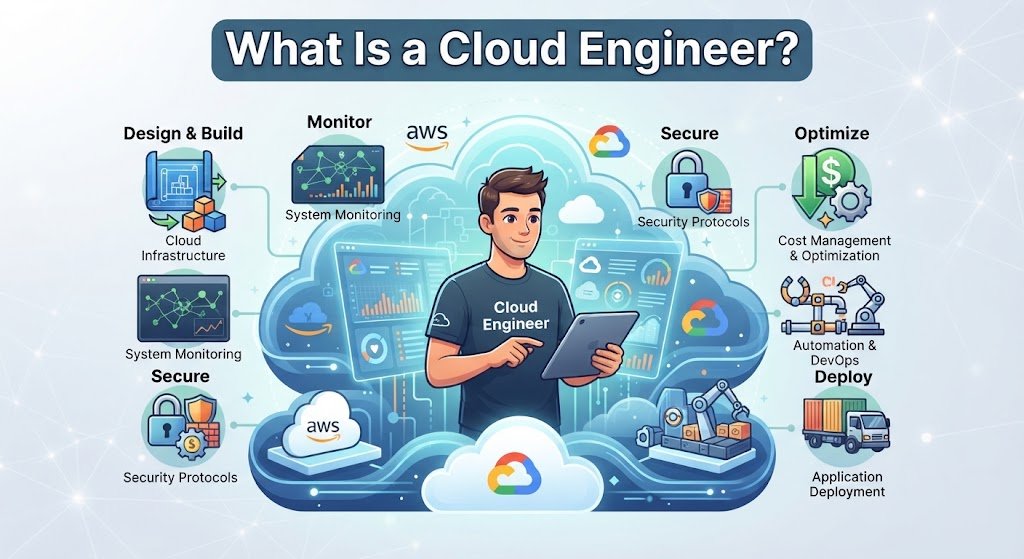
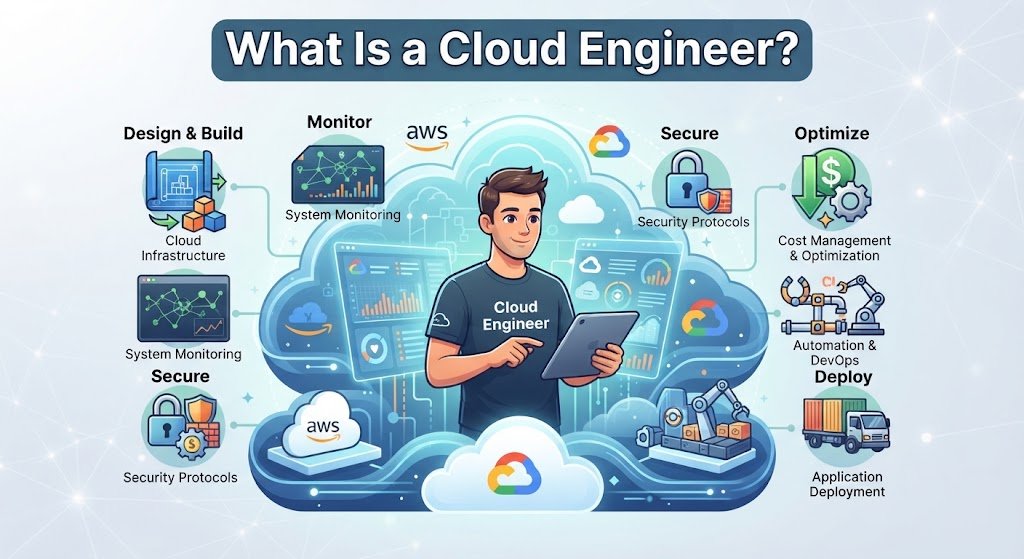
A cloud engineer is an IT professional who designs, builds, manages, and maintains cloud-based systems.
Instead of working only with physical servers in a company building, cloud engineers often work with services provided by platforms such as AWS, Microsoft Azure, and Google Cloud.
Their work can include setting up virtual servers, managing storage, configuring networks, protecting data, monitoring applications, and solving technical problems.
What I find interesting about this career is that cloud engineering is not limited to one type of work. A cloud engineer may work with networking in the morning, solve a security problem later, and then help deploy an application in the afternoon.
What Is Cloud Engineering?
If you are wondering what is cloud engineering, the simple answer is that it is the process of designing, building, managing, and improving systems that run on cloud platforms.
Cloud engineering combines several areas of technology, including:
- Cloud computing
- Networking
- Security
- Automation
- Programming
- Storage
- Databases
- DevOps
- System monitoring
The main goal is to create cloud systems that are reliable, secure, flexible, and easy to manage.
For example, an online store may need servers that can handle thousands of visitors during a sale. A cloud engineer can help create an environment that increases resources when traffic becomes high and reduces them when traffic goes down.

What Does a Cloud Engineer Do?
The daily work of a cloud engineer can change depending on the company and project. However, several responsibilities are common.
Design Cloud Infrastructure
Cloud engineers design the basic environment needed to run applications and services.
They may decide how servers, storage, networks, databases, and other cloud services should work together.
Good planning is important because a poorly designed cloud environment can become expensive or difficult to maintain.
Deploy Applications
Cloud engineers help teams move applications from development environments into production.
They may configure servers, containers, databases, networking, and other services required by an application.
Manage Cloud Resources
Cloud environments contain many resources. Someone needs to monitor and manage them.
A cloud engineer may create new resources, remove unused ones, update systems, and make sure the infrastructure has enough capacity.
Monitor Performance
Monitoring is another important part of the job.
Cloud engineers watch systems for problems such as high CPU usage, slow applications, storage issues, network problems, and unexpected downtime.
Finding a problem early can prevent a small issue from becoming a major outage.

Improve Security
Security is one of the most important responsibilities in cloud computing.
Cloud engineers can work with access controls, authentication, encryption, firewalls, security rules, and monitoring tools.
The goal is to make sure that only authorized people and applications can access important resources.
Control Cloud Costs
Cloud services can become expensive if resources are not managed properly.
A cloud engineer can identify unused servers, unnecessary storage, oversized resources, and other areas where money can be saved.
This is something I think every beginner should understand: learning cloud technology is not only about making systems work. It is also about making them work efficiently.
Skills a Cloud Engineer Needs
You do not need to know everything on your first day. However, building a strong foundation can make learning cloud engineering much easier.
Cloud Computing
First, you should understand basic cloud concepts such as virtual machines, storage, databases, networking, regions, availability zones, and cloud services.
Once these ideas become clear, learning a specific cloud platform becomes easier.

Networking
Networking is a major part of cloud engineering.
You should understand concepts such as IP addresses, DNS, ports, firewalls, routing, VPNs, and load balancing.
Without basic networking knowledge, many cloud problems can be difficult to understand.
Linux
Linux is widely used in cloud environments, so learning basic Linux commands is very useful.
You should know how to navigate files, manage processes, check system resources, install packages, and work with permissions.
Programming and Scripting
You do not necessarily need to become a professional software developer, but programming and scripting skills can make your work much easier.
Python, Bash, and PowerShell are useful examples.
Automation is one of the biggest reasons to learn scripting. Instead of doing the same task manually hundreds of times, you can create a script to do it for you.
Security
Basic security knowledge is also important.
You should understand identity and access management, permissions, encryption, authentication, and common security risks.
Automation and DevOps
Modern cloud teams rely heavily on automation.
Tools and practices related to CI/CD, Infrastructure as Code, containers, and automated testing can help teams deploy applications faster and more safely.
Popular Cloud Platforms
There are several major cloud platforms that cloud engineers commonly work with.
Amazon Web Services
Amazon Web Services, or AWS, provides a large collection of cloud services.
Some well-known services include EC2 for computing, S3 for storage, Lambda for serverless computing, and VPC for networking.

Microsoft Azure
Microsoft Azure is another major cloud platform.
It provides services for computing, storage, databases, networking, security, AI, and many other business needs.
Azure can be especially useful for organizations that already use many Microsoft products.
Google Cloud
Google Cloud provides cloud infrastructure along with services for data, AI, machine learning, application development, and more.
Google’s cloud platform is also closely connected with Google’s work in artificial intelligence and data processing.
Cloud Engineering and Generative AI
Cloud engineering is also becoming more connected with artificial intelligence.
If you have ever wondered which task is a generative AI task, a simple example is creating new content from a user’s prompt. Generative AI can produce text, images, code, summaries, and other forms of content.
Cloud platforms provide the computing power and services needed to build and run many AI applications.
For example, a company may build an AI-powered customer support system that uses cloud infrastructure to process user questions and generate responses.
This means cloud engineers may increasingly work with AI services, data pipelines, model deployment, security, and the infrastructure required to run AI applications.

What Is Google Cloud Document AI?
Another interesting cloud-based AI service is Google Cloud Document AI.
It is designed to help businesses process documents and extract useful information from them.
For example, a business may receive thousands of invoices, forms, or other documents. Processing all of this information manually can take a lot of time.
Document AI can help extract information from documents and turn unstructured document content into useful data.
A cloud engineer may help create and manage the cloud infrastructure needed for such a solution.
This is a good example of how cloud engineering is moving beyond traditional servers and storage. Today, cloud engineers may support applications involving AI, automation, data processing, and machine learning.
Cloud Engineer vs Cloud Architect
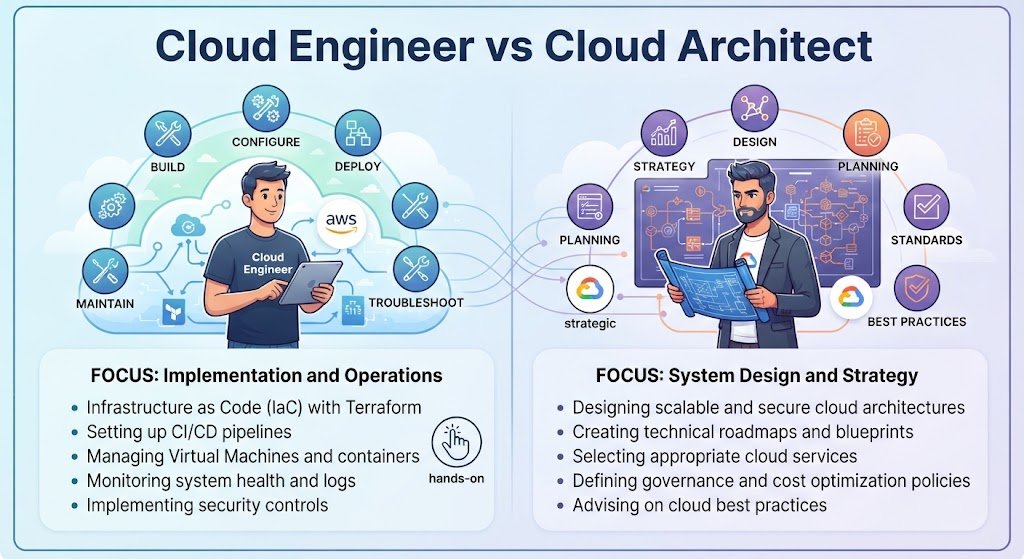
Cloud engineer and cloud architect are related roles, but they are not exactly the same.
A cloud architect usually focuses more on the overall design of a cloud environment. They make high-level decisions about how different systems should work together.
A cloud engineer is often more involved in building, configuring, deploying, and maintaining those systems.
In smaller companies, one person may perform responsibilities from both roles.
Cloud Engineer vs DevOps Engineer
There is also a lot of overlap between cloud engineering and DevOps.
A DevOps engineer often focuses heavily on automation, software delivery, CI/CD pipelines, infrastructure, and improving the development and operations process.
A cloud engineer may focus more broadly on cloud infrastructure, networking, storage, security, and cloud services.
The exact responsibilities depend on the company, so job titles should not be treated as strict rules.
Important Tools for Cloud Engineers
Cloud engineers use many different tools depending on their projects.
Some common categories include:
- Cloud platforms such as AWS, Azure, and Google Cloud
- Docker for containers
- Kubernetes for container management
- Terraform for Infrastructure as Code
- Git for version control
- CI/CD tools for automated deployment
- Monitoring and logging tools for system health
You do not need to learn every tool at once.
I recommend learning the basic cloud concepts first and then adding tools as you build projects. This approach makes the learning process much less confusing.
How to Become a Cloud Engineer
If I were starting from the beginning today, I would follow a simple path.
Step 1: Learn IT Basics
Start with computers, operating systems, networking, and basic troubleshooting.
Step 2: Learn Linux
Practice Linux commands and learn how servers work.
Step 3: Learn Cloud Fundamentals
Choose one platform and learn its basic services.
AWS, Azure, and Google Cloud are all good options.
Step 4: Learn Networking
Understand IP addresses, DNS, routing, firewalls, and load balancing.
Step 5: Learn Automation
Start with simple Bash or Python scripts and gradually move toward Infrastructure as Code.
Step 6: Build Projects
This is one of the most important steps.
Do not only watch courses. Build something.
For example, you could deploy a simple website, create a cloud database, set up monitoring, or build a small automated deployment pipeline.
Projects help you understand how different cloud services work together.
Step 7: Consider Certifications
Certifications can help show your knowledge, especially when you are starting your career.
However, I would not depend on certifications alone. Practical experience and projects are equally important.
Is Cloud Engineering a Good Career?
In my view, cloud engineering can be a strong career choice for people who enjoy technology, problem-solving, and continuous learning.
The field changes regularly, so there is always something new to learn. Cloud platforms introduce new services, security practices change, and technologies such as containers, automation, and AI continue to develop.
The career can also lead to other roles, including:
- Cloud DevOps Engineer
- Cloud Security Engineer
- Cloud Architect
- Site Reliability Engineer
- Platform Engineer
- Infrastructure Engineer
The important thing is to build real skills instead of simply collecting tools and certifications.
Frequently Asked Questions
What is a cloud engineer?
A cloud engineer is an IT professional who builds, manages, secures, and maintains cloud-based infrastructure and applications.
What is cloud engineering?
Cloud engineering is the design, development, deployment, and management of systems that use cloud computing services.
Do cloud engineers need coding skills?
Basic programming and scripting skills are very useful. You do not necessarily need advanced software development skills, but knowing Python, Bash, or another scripting language can help with automation.
Which cloud platform should beginners learn?
AWS, Azure, and Google Cloud are all useful choices. Beginners should usually choose one platform and learn its fundamentals instead of trying to learn all three at the same time.
Is cloud engineering difficult?
It can feel difficult at first because it combines networking, operating systems, security, programming, and cloud services. However, learning one concept at a time and building practical projects can make the process much easier.
Can AI replace cloud engineers?
AI can automate some cloud-related tasks, but businesses still need skilled professionals to design systems, manage infrastructure, make security decisions, solve complex problems, and connect different technologies.
Final Thoughts
Becoming a cloud engineer is not about memorizing hundreds of cloud services. It is about understanding how technology works and learning how to build reliable systems with cloud platforms.
When I look at cloud engineering as a career, the most valuable combination is simple: strong fundamentals, practical experience, automation skills, security awareness, and a willingness to keep learning.
Start with one cloud platform, learn the basics, build real projects, and improve step by step. You do not need to know everything before starting. With consistent practice, cloud engineering can become a rewarding and useful technology career.