
Buildings are becoming more connected, automated, and intelligent than ever before. From offices and shopping centers to hospitals, hotels, and residential properties, modern facilities are using technology to improve the way they operate. One of the most important developments in this area is smart building AI, which combines artificial intelligence with connected building systems to make buildings more efficient, secure, comfortable, and easier to manage.
Unlike traditional automation, AI can analyze large amounts of information, recognize patterns, predict future conditions, and support better decisions. This allows building owners and facility managers to move from simply reacting to problems toward preventing them before they happen.
In this guide, we will explore how AI is transforming buildings, the technologies behind intelligent facilities, their major benefits, challenges, applications, and what the future may hold.
What Is Smart Building AI?
Smart building AI refers to the use of artificial intelligence, machine learning, sensors, connected devices, and data analytics to improve building operations.
A conventional building may use separate systems for heating, cooling, lighting, security, and energy management. An AI-powered building can connect information from these systems and analyze it together.
For example, sensors can detect that fewer people are using a particular area of an office. AI can analyze this information and help adjust lighting or temperature settings accordingly. Similarly, an intelligent system can identify unusual equipment behavior and alert facility managers before a major failure occurs.
The goal is not simply to automate more tasks. The real advantage is using building data to make operations smarter and more responsive.

How Does Smart Building AI Work?
AI-powered buildings generally depend on several connected components working together.
1. Sensors and IoT Devices
Sensors collect information about temperature, humidity, occupancy, air quality, energy use, lighting, and equipment performance. IoT devices allow this information to move between connected systems.
2. Data Collection
The building continuously generates operational data. This data can come from HVAC equipment, lighting systems, access controls, smart meters, elevators, cameras, and other connected devices.
3. AI and Machine Learning
AI software analyzes collected information and looks for patterns. Machine learning can help systems understand normal building behavior and identify unusual conditions.
4. Automated Decisions
Based on available information, AI can recommend or trigger actions. For example, a system may adjust temperature settings when occupancy changes or identify equipment that requires inspection.
5. Continuous Improvement
As more information becomes available, AI systems can improve their understanding of the building and provide more useful predictions and recommendations.

Smart Building Technologies That Power Modern Buildings
Modern facilities rely on a combination of connected technologies. These smart building technologies provide the data and control capabilities that make intelligent operations possible.
Common technologies include:
- IoT sensors
- Smart thermostats
- Intelligent lighting systems
- Occupancy sensors
- Smart meters
- Connected HVAC equipment
- Digital access-control systems
- Building analytics platforms
- Cloud-based management tools
- Predictive maintenance systems
These technologies become more powerful when they can communicate with each other instead of operating as isolated systems.
For example, occupancy data can be shared with lighting and HVAC controls. This can help a building respond to real-time usage instead of following a fixed schedule.

Intelligent Building Solutions for Better Performance
Modern intelligent building solutions are designed to improve several aspects of building performance at the same time.
Energy management is one of the most important applications. AI can examine energy patterns and identify opportunities for reducing unnecessary consumption.
Climate control is another major area. Instead of maintaining identical conditions throughout an entire facility, intelligent systems can respond to occupancy, weather conditions, and other factors.
Security can also benefit from connected technology. Access-control systems, sensors, and analytics can help identify unusual activity and provide faster alerts.
AI can also support space management. Facility managers can understand which rooms and areas are frequently used and which spaces may be underutilized.
The result is a building that can respond more intelligently to changing conditions.
Smart Building Monitoring: What Can AI Track?
Smart building monitoring allows facility managers to understand what is happening inside a building in real time.
Depending on the system, AI can help monitor:
- Energy consumption
- Temperature
- Humidity
- Indoor air quality
- Occupancy levels
- Lighting conditions
- HVAC performance
- Equipment behavior
- Security events
- Water usage
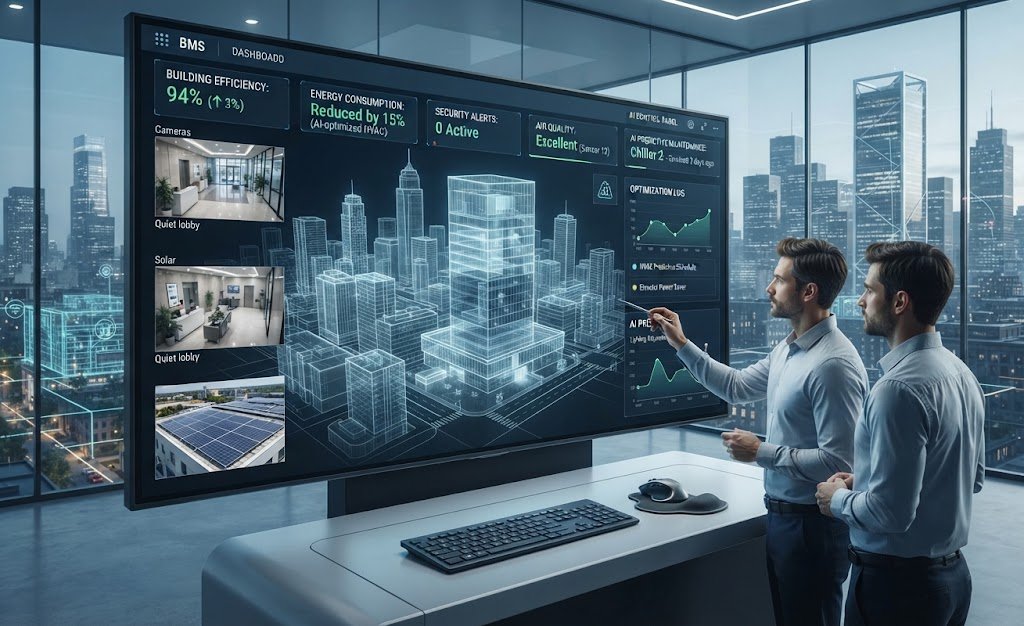
This information can be displayed through dashboards and alerts, giving managers a clearer view of building performance.
For example, if an HVAC unit begins consuming more energy than usual, the system may identify the unusual pattern. A facility manager can then investigate the equipment before the problem becomes more expensive.
Monitoring also makes it easier to compare current performance with historical patterns and identify areas that need improvement.

Smart Building Management System and AI
A smart building management system brings multiple building functions into a centralized environment. When AI capabilities are added, the system can go beyond basic monitoring and scheduled automation.
A traditional management system may follow predefined instructions. An AI-enhanced system can analyze current conditions and historical data to provide more adaptive recommendations.
For example, the system could consider occupancy, temperature, equipment performance, and energy demand when optimizing building operations.
A smart building management system can potentially help manage:
- HVAC
- Lighting
- Energy systems
- Access control
- Alarms
- Environmental conditions
- Equipment monitoring
Centralized management can also make it easier for facility teams to identify problems quickly rather than checking several disconnected systems.
8 Powerful Benefits of Smart Building AI
1. Improved Energy Efficiency
Energy efficiency is one of the strongest reasons organizations invest in intelligent building technology. AI can identify unnecessary energy consumption and help optimize heating, cooling, and lighting.
Instead of operating equipment according to fixed schedules, systems can respond to actual building conditions.
2. Lower Operating Costs
Better energy management and predictive maintenance can contribute to lower operational expenses. Identifying equipment problems earlier may also help reduce costly emergency repairs.
3. Better Building Security
Connected sensors and intelligent analytics can support modern security strategies. Unusual access events or abnormal activity can generate alerts for facility teams.
AI does not replace professional security procedures, but it can provide additional information that helps teams respond more efficiently.
4. Predictive Maintenance
Traditional maintenance often follows fixed schedules or waits until equipment fails. AI can analyze equipment behavior and identify signs of potential problems.
This predictive approach can help organizations plan maintenance before a serious failure occurs.
5. Greater Occupant Comfort
People expect buildings to provide comfortable temperatures, good lighting, and healthy indoor environments.
AI can help building systems respond to occupancy and environmental conditions, creating a more comfortable experience for occupants.
6. Smarter Space Utilization
Buildings often contain spaces that are rarely used. Occupancy information can help organizations understand how their facilities are actually being used.
This information can support better decisions about meeting rooms, workspaces, common areas, and other facilities.
7. Faster Decision-Making
Instead of manually reviewing large amounts of building data, facility teams can use AI-generated insights to identify important trends and potential problems more quickly.
8. Better Sustainability
Reducing unnecessary energy and resource consumption can support broader sustainability objectives. AI can help organizations understand where resources are being used and where improvements may be possible.

Real-World Applications of AI in Smart Buildings
The potential applications of AI extend across many building functions.
AI-Powered HVAC Optimization
Heating and cooling can account for a significant portion of building energy use. AI can analyze occupancy, environmental conditions, and equipment performance to support more efficient HVAC operation.
Intelligent Lighting
Smart lighting can respond to occupancy and available natural light. Lights may be dimmed or adjusted when areas are empty, depending on the system configuration.
Occupancy Prediction
AI can analyze historical usage patterns to help predict when particular areas are likely to be occupied. This can support planning for lighting, HVAC, and facility services.
Energy Forecasting
AI can examine historical energy data and other operational information to identify consumption patterns and support energy planning.
Predictive Equipment Maintenance
Equipment sensors can provide information about performance. AI can identify unusual changes and help maintenance teams determine which assets may require attention.
Security and Anomaly Detection
AI-based analytics can help identify unusual patterns in access or building activity and provide alerts for further investigation.
Digital Building Blocks: The Foundation of Smart Buildings
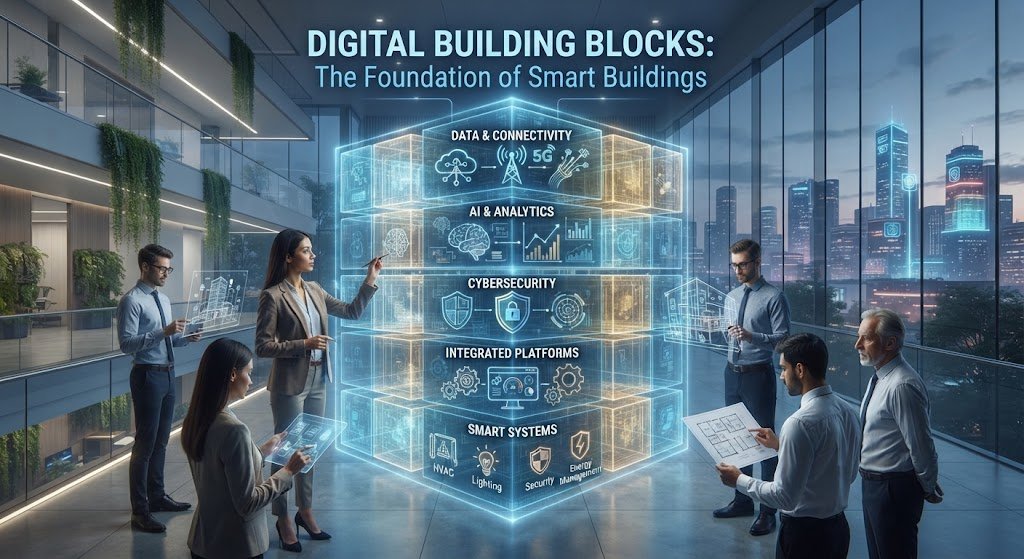
Digital building blocks are the underlying technologies and infrastructure that allow an intelligent facility to operate effectively.
These can include sensors, connectivity, software platforms, cloud services, data storage, APIs, analytics tools, and AI models.
A building does not become intelligent simply by installing a few smart devices. These technologies need to work together and exchange useful information.
Good digital infrastructure should also be scalable. As a building grows or new technologies become available, the system should ideally be able to accommodate additional devices and applications.
This is why planning the digital foundation is an important part of a successful smart-building strategy.
Challenges of Using Smart Building AI
Although AI offers many advantages, implementation also comes with challenges.
Initial Investment
Installing sensors, connected equipment, software, and networking infrastructure can require significant upfront investment.
Cybersecurity
More connected devices can create more potential entry points for cyber threats. Strong authentication, software updates, access controls, and network security are important.
Data Privacy
Some smart-building systems collect information related to occupants and building usage. Organizations need appropriate policies for handling and protecting sensitive information.
Legacy Systems
Older buildings may contain equipment that was not designed to communicate with modern platforms. Integrating legacy systems can therefore require additional planning.
Data Quality
AI depends on useful data. Poorly configured sensors, missing information, or inaccurate measurements can reduce the quality of system recommendations.
Technical Expertise
Organizations may need skilled professionals who understand building systems, networking, data analytics, cybersecurity, and AI.

Smart Building AI vs Traditional Building Automation
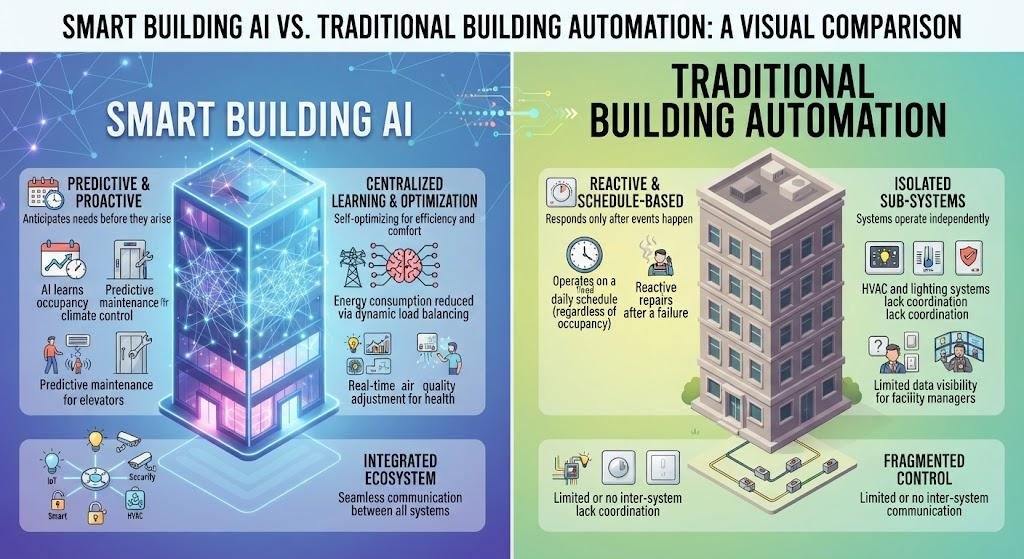
Traditional building automation generally follows predefined rules and schedules. For example, a system may turn lights on at a specific time every morning.
AI-powered systems can take a more adaptive approach. They can analyze information from multiple sources and identify patterns that may not be obvious through fixed rules.
The key differences include:
| Feature | Traditional Automation | AI-Powered Building |
| Decision-making | Rule-based | Data-driven |
| Data analysis | Limited | Advanced |
| Adaptability | Moderate | High |
| Maintenance | Scheduled/reactive | Predictive |
| Optimization | Predefined | Dynamic |
| Scalability | Depends on system | Designed for connected environments |
Traditional automation still has an important role, but AI can add another layer of intelligence and optimization.
Latest Smart Building News and Emerging Trends
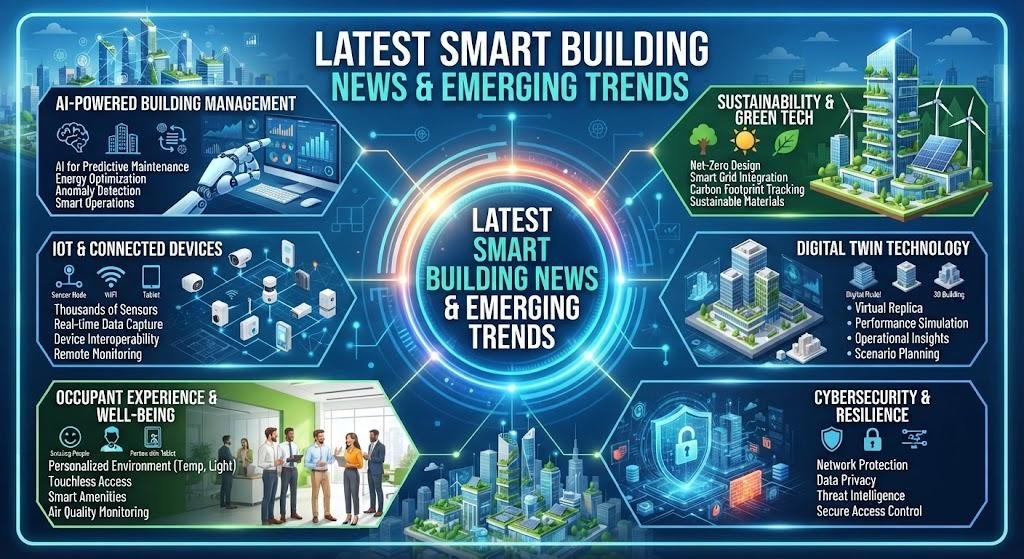
The smart building news landscape continues to evolve as AI, IoT, cloud computing, and automation become more closely connected.
One important trend is the use of generative AI and conversational interfaces to make building data easier to understand. Instead of reviewing complicated dashboards, facility teams may increasingly interact with systems using natural language.
Digital twins are another important development. A digital twin can represent aspects of a physical building digitally and provide a way to analyze operations and potential changes.
Edge AI is also gaining attention because processing information closer to connected devices can reduce reliance on distant cloud systems for certain applications.
Other emerging trends include autonomous building operations, advanced occupancy analytics, renewable-energy integration, and increasingly sophisticated predictive maintenance.
How to Implement Smart Building AI
Organizations should approach implementation strategically rather than attempting to automate everything at once.
Step 1: Assess the Existing Building
Review current equipment, systems, energy usage, connectivity, and operational challenges.
Step 2: Define Your Goals
Determine whether the main objective is energy efficiency, security, maintenance, comfort, sustainability, or a combination of these goals.
Step 3: Install Smart Sensors
Add appropriate sensors and connected devices where reliable operational data is needed.
Step 4: Connect Existing Systems
Where possible, integrate HVAC, lighting, security, energy, and other building systems into a coordinated platform.
Step 5: Introduce AI Analytics
Use AI to analyze collected data and identify patterns, inefficiencies, and potential problems.
Step 6: Automate Key Processes
Start with high-value applications such as HVAC optimization, lighting control, or predictive maintenance.
Step 7: Monitor and Optimize
Regularly evaluate system performance and adjust the strategy as building needs change.
The Future of Smart Building AI
The future of intelligent buildings is likely to involve deeper connections between AI, IoT, renewable energy, digital twins, and automation.
Buildings may become increasingly capable of adjusting their operations based on real-time conditions. Energy systems could coordinate more effectively with renewable generation and changing demand. Maintenance could become more predictive, while occupants may receive more personalized environmental experiences.
However, the goal should not be automation simply for its own sake. Successful intelligent buildings will combine technology with practical building management, cybersecurity, privacy, and human oversight.
As AI technology continues to develop, buildings can become more responsive, efficient, and sustainable while giving facility teams better information for everyday decisions.
FAQs About Smart Building AI
What is smart building AI?
It is the use of artificial intelligence, connected devices, sensors, and data analytics to improve building operations, efficiency, security, comfort, and maintenance.
How does AI make buildings smarter?
AI analyzes information from building systems, identifies patterns, predicts potential issues, and can support automated or data-driven decisions.
What technologies are used in smart buildings?
Common technologies include IoT sensors, smart HVAC systems, intelligent lighting, occupancy sensors, energy meters, connected security systems, cloud platforms, and AI analytics.
Can AI reduce building energy consumption?
AI can help identify inefficient energy use and optimize systems such as HVAC and lighting based on building conditions and usage patterns.
What is a smart building management system?
It is a centralized platform that can monitor and manage multiple building systems. AI can add predictive analytics and adaptive decision-making capabilities.
Are AI-powered buildings secure?
They can be designed with strong cybersecurity measures, but connected systems require ongoing security management, access controls, monitoring, and software updates.
Conclusion
Smart building AI is changing how modern facilities are designed, operated, and managed. By combining sensors, IoT connectivity, data analytics, machine learning, and automation, intelligent buildings can respond more effectively to changing conditions.
From energy optimization and predictive maintenance to security and occupant comfort, AI has applications across many areas of building management. However, successful implementation requires more than installing technology. Organizations also need reliable data, secure infrastructure, appropriate integration, and clear operational goals.
As technology continues to evolve, intelligent buildings are likely to become more connected, adaptive, and sustainable. For organizations looking to modernize their facilities, AI can provide a powerful foundation for smarter building operations and better long-term performance.